A glass-box model exposes an internal structure that people can inspect to understand how inputs produce predictions. Its interpretability is inherent: the model’s rules, components, or weights are comprehensible rather than hidden behind opaque computation. This transparency supports trust in high-stakes decisions and helps uncover failure cases, bias, and data problems during debugging. section 9.0 section 9.1.1
Figure 9.1 With black-box machine-learning models, we can only use the input-output pairs to analyze and explain model behavior. The model internals in a black box are either unavailable or aren’t directly interpretable. With glass-box machine-learning models, in addition to input-output pairs, the model internals are also intuitively interpretable.
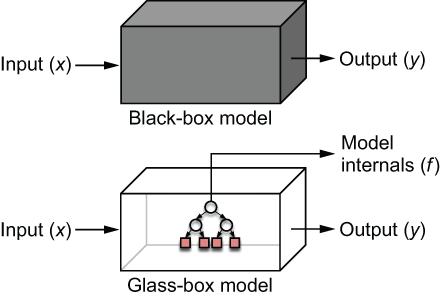
Compare what can be inspected: black-box explanations work from inputs and outputs, while glass-box models also reveal interpretable internals. section 9.1.1
Interpretability does not simply mean that a model is available to inspect. A fourth-degree polynomial classifier can expose all its parameters while still obscuring whether age, blood glucose, or their combination drove a diabetes prediction. A decision tree with similar predictive performance instead states its reasoning as feature tests and branches, making the decision path directly readable. section 9.1.1 section 9.6
Common glass-box forms make contributions visible in different ways:
- Decision trees express prediction as sequential feature questions. Each root-to-leaf path is a decision rule that partitions examples into a subpopulation. section 9.1.2
- Generalized linear models expose feature weights, which can be interpreted as each feature’s contribution to the overall decision. section 9.6
- Explainable boosting machines (EBMs) use inspectable nonlinear components for individual features and selected feature pairs, avoiding every possible interaction. section 9.5.1
Reading a tree as rules
For Iris classification, a small decision tree reaches over 90% accuracy using only petal width and petal length. Its three leaves become readable rules: low petal width predicts Iris-Setosa; larger width combined with shorter or longer petal length separates Iris-Versicolour from Iris-Virginica. The visualization reveals both the prediction logic and that two available features were unused. section 9.1.2
Glass-box does not mean unlimited complexity remains understandable. A decision tree becomes less intuitive as its depth and number of leaves grow. EBMs preserve a glass-box structure by limiting their components to one-feature effects and a small set of important pairwise interactions; each learned component can then be visualized and assigned a contribution to a prediction. section 9.6 section 9.5.1 section 9.5.2
A glass-box model can also explain a black-box model indirectly. A global surrogate is a second, interpretable model trained on the black box’s predictions using representative data. If its predictions closely match the original, inspecting the surrogate offers a global account of black-box behavior. The key tradeoff is fidelity versus explainability: a larger surrogate may mimic more behavior while becoming harder to read. section 9.3.3 section 9.6
Explainable ensemble components
An EBM for diabetes diagnosis can contain separate components for age, blood glucose, and body mass index, plus only a selected pairwise interaction. For a bank-marketing prediction, its local explanation can show positive or negative contributions from individual features and interactions such as month × day_of_week, while global views summarize feature importance. section 9.5.1 section 9.5.2
