A global address is an IP address viewed from the outside network after NAT. An outside global address specifically identifies an outside host from the outside network’s perspective. section 9.2.2 section 9.4
Use the four NAT address terms by separating two perspectives:
- Inside global: an inside host’s address as seen from the outside network, usually its public, post-NAT address. section 9.4
- Outside global: an outside host’s address as seen from the outside network. section 9.2.2 section 9.4
- Outside local: the outside host’s address as seen from the inside network. section 9.4
- Inside and outside depend on the router’s perspective: an Internet host can regard the internal network as outside. section 9.2.2
Reading a NAT translation
For a connection from 10.0.0.11 to an HTTPS server at 34.117.65.55, the translation table can show 192.0.2.1 as the inside global address and 34.117.65.55 as both the outside local and outside global address. They match because no destination NAT changes the outside host’s address. section 9.3.1 section 9.4
Figure 9.5 Inside local, inside global, outside local, and outside global addresses. The inside/outside distinction differentiates between hosts located in the inside and outside networks, and the local/global distinction differentiates between the perspectives of hosts in the inside and outside networks.
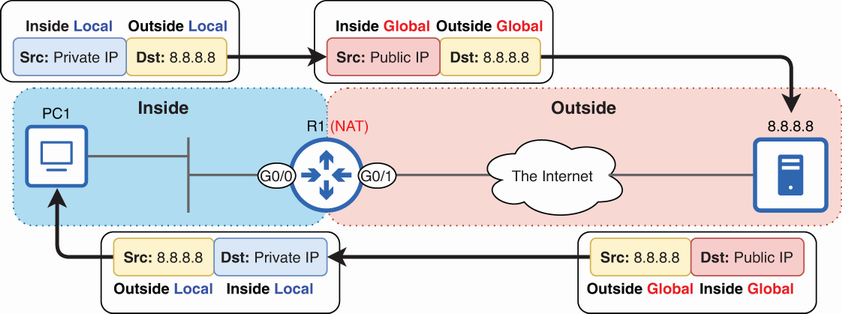
Use the address map to compare inside local, inside global, outside local, and outside global from the router’s two perspectives. section 9.2.2
