An inside local address is the IP address of a host on the inside network before NAT translation, viewed from the inside network. For example, PC1’s 10.0.0.11 is its inside local address before translation to an inside global address. NAT terminology depends on perspective: inside means the internal network, while local means pre-NAT. section 9.2.2 section 9.4
Distinguish inside local addresses from the other NAT address categories:
- Inside global identifies the inside host from the outside network after translation. section 9.2.2
- Outside local identifies the outside host from the inside network; outside global identifies it from the outside network. section 9.2.2 section 9.4
- Router interfaces configured with ip nat inside and ip nat outside establish the inside and outside perspectives used by NAT. section 9.2.2 section 9.4
Static NAT mapping
R1(config)# ip nat inside source static 10.0.0.11 192.0.2.1 This maps inside local address 10.0.0.11 to inside global address 192.0.2.1. The command show ip nat translations displays both values, with 10.0.0.11 in the Inside local column. Static NAT creates a one-to-one mapping; dynamic NAT instead assigns inside global addresses from a configured pool. section 9.3.1
Figure 9.5 Inside local, inside global, outside local, and outside global addresses. The inside/outside distinction differentiates between hosts located in the inside and outside networks, and the local/global distinction differentiates between the perspectives of hosts in the inside and outside networks.
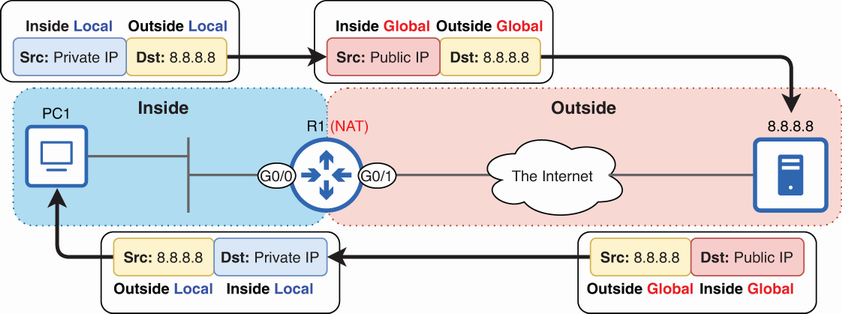
Use the address-perspective diagram to compare inside local, inside global, outside local, and outside global addresses across the NAT boundary. section 9.2.2
