Go is a two-player strategy board game in which players place stones on a grid to control territory and capture opposing stones. Its enormous range of possible positions makes complete move-by-move prediction impractical, creating a demanding test for strategic reasoning. section 13.3.3
Go became a landmark example of AI strategy because:
- AlphaGo defeated leading human players, including Lee Sedol and Ke Jie. section 13.3.1 section 13.3.2
- AlphaGo Zero received only the rules of Go, without prior games, human coaching, programming instructions, or expert tips. section 13.3.1
- Its deep-learning system developed unfamiliar strategies that human experts initially found strange or incomprehensible. section 13.3.1 section 13.3.2
AlphaGo’s Move 37
During the second game against Lee Sedol in 2016, AlphaGo played Move 37. Experienced players initially viewed it as a mistake, but it became central to the victory and was later celebrated for challenging centuries of traditional Go knowledge. section 13.3.2
Figure 13.1 Even a simple game like tic-tac-toe with only nine squares has a fairly complex game tree diagram.
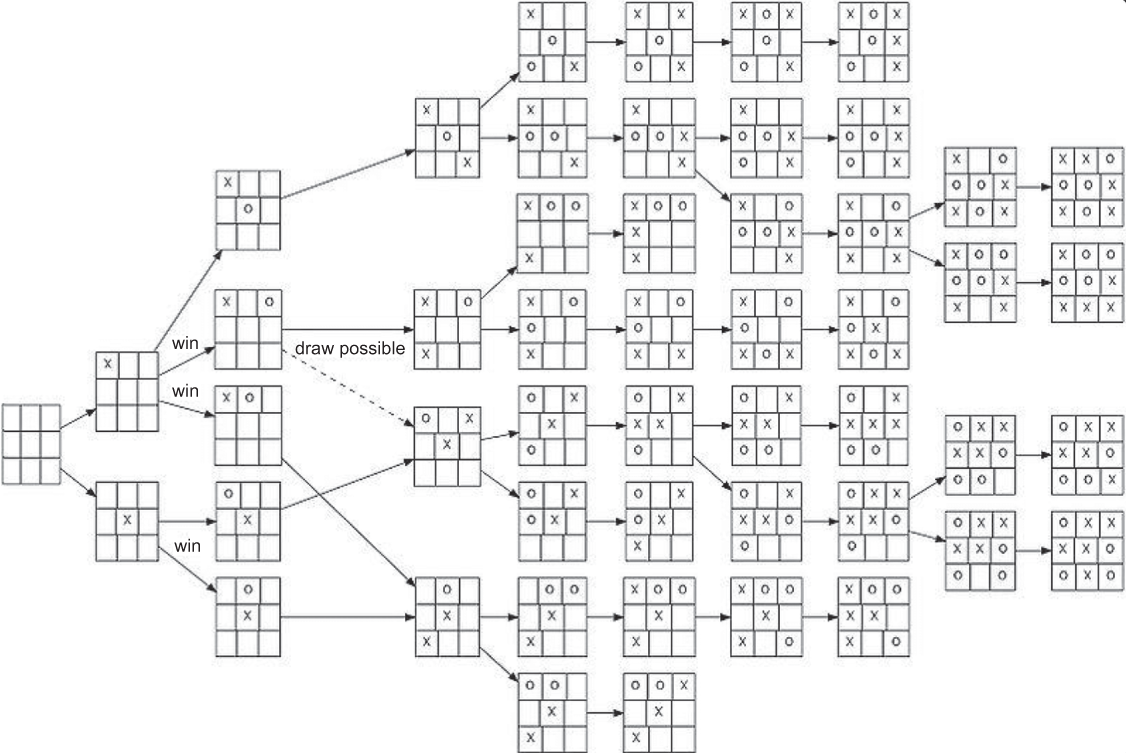
A game-tree diagram makes the scale of Go’s possible decisions easier to appreciate by comparing it with the smaller search space of tic-tac-toe. section 13.3.3
