Governance is the way rules are made, owned, and kept aligned with organizational intent. In authorization, it connects management goals, regulatory requirements, fairness, security, and operational tradeoffs to the policies that systems enforce. Technology can verify identities and apply rules, but governance determines whether those rules are appropriate, accountable, and trustworthy. section 2.6.4 section 2.9
A governance framework assigns responsibility for a policy life cycle, sets standards, and coordinates work when policies span teams or systems. It links engineering authorship and deployment, operational monitoring, and oversight review so that policy decisions remain traceable, explainable, and responsive to evidence. section 14.3 section 14.0
Policy governance treats authorization policies as managed production artifacts:
- Assign an owner, author, reviewer, and approver so responsibility continues after deployment. section 14.3.1 section 14.6
- Use shared naming, templates, metadata, documentation, testing, version control, and deployment practices across teams. section 14.3.1 section 14.6
- Review, monitor, update, and retire policies deliberately as business priorities, regulations, risks, and systems change. section 14.2.5 section 14.2.6
- Feed incidents, audit findings, access reviews, and monitoring results back into policy decisions. section 14.3.1 section 14.6
Preventing policy drift
Separate teams can maintain locally sensible policies that gradually lose their connection to shared intent. The result may be orphaned rules, excessive restrictions, or policies that no longer match operations. A federated model preserves team ownership while central standards, review processes, templates, and decision records make policies visible and comparable across the organization. section 14.1 section 14.3.1
Figure 14.4 Federated policy governance restoring alignment. Policy governance sits between organizational intent and team-owned policies, providing shared standards, templates, and reviews without centralizing control. Individual teams retain ownership of their policies, while governance ensures that those policies are reviewed, ADR-linked, and aligned with organizational intent.
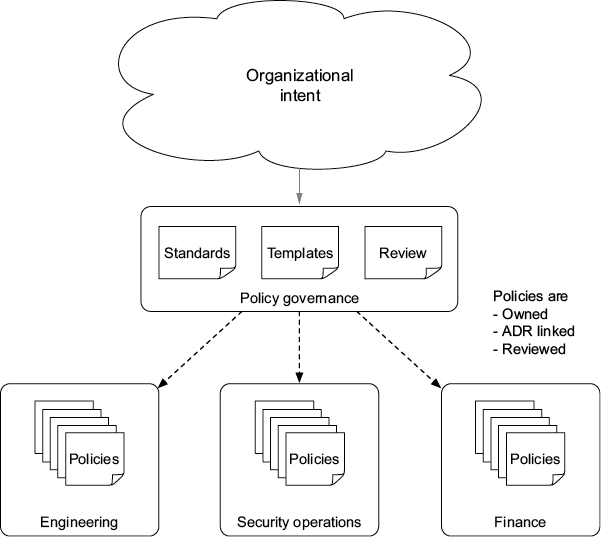
This diagram shows governance as the coordination layer between organizational intent and team-owned policies, restoring alignment without centralizing every decision. section 14.3.1
Governance complements Identity Governance and Administration (IGA). IGA manages identity data, entitlements, approvals, and certifications; policy governance governs how those inputs are interpreted at runtime. Combining entitlement reviews with decision logs can expose stale access and unexpected authorization paths. section 14.4 section 14.9
Governance also turns compliance demands into inspectable evidence. Policy text, decision records, version history, reviews, test results, metadata, and runtime logs can connect a requirement to the rule and its observed behavior. Start pragmatically with documented decisions, assigned ownership, periodic review, peer review, and version control rather than adding ceremony without evidence. section 14.5 section 14.7
Beyond internal policies, governance establishes trust in external credential issuers. A governance authority can define issuer qualifications, accreditation, supervision, and accountability; a verifier then uses that framework to decide which issuer claims are acceptable for which purposes. section 16.3 section 16.9.3




