Data governance provides the policies, roles, standards, and controls needed to manage data availability, quality, security, and compliance across a Snowflake data pipeline. It operates alongside extraction, ingestion, transformation, and presentation rather than as a separate pipeline stage. section 1.2 section 10.0
A governed pipeline incorporates access requirements while data is being built so users see only information they are authorized to access. Snowflake implements this boundary through role-based access control and policy-based restrictions. section 10.0
Core Snowflake governance mechanisms include:
- Role-based access control assigns access privileges to roles and grants those roles to users. section 10.0
- Row access policies restrict records by business unit, supporting multitenant data stores where units share a database. section 10.0
- Masking policies hide sensitive personal or financial information when users query tables. section 10.0
Bakery business-unit controls
A bakery separates data engineer and data analyst roles: engineers read and write data, while analysts read only. As bread and pastry operations expand, each business-unit manager sees only that unit’s records, and personal data appears masked in query results. section 10.0
Figure 1.2 Data engineering components with Snowflake include extracting data from source systems, ingesting the data into Snowflake, performing transformations, and presenting the data to downstream consumers, incorporating underlying components and best practices related to security, data modeling, data governance, orchestration, software engineering, and DataOps.
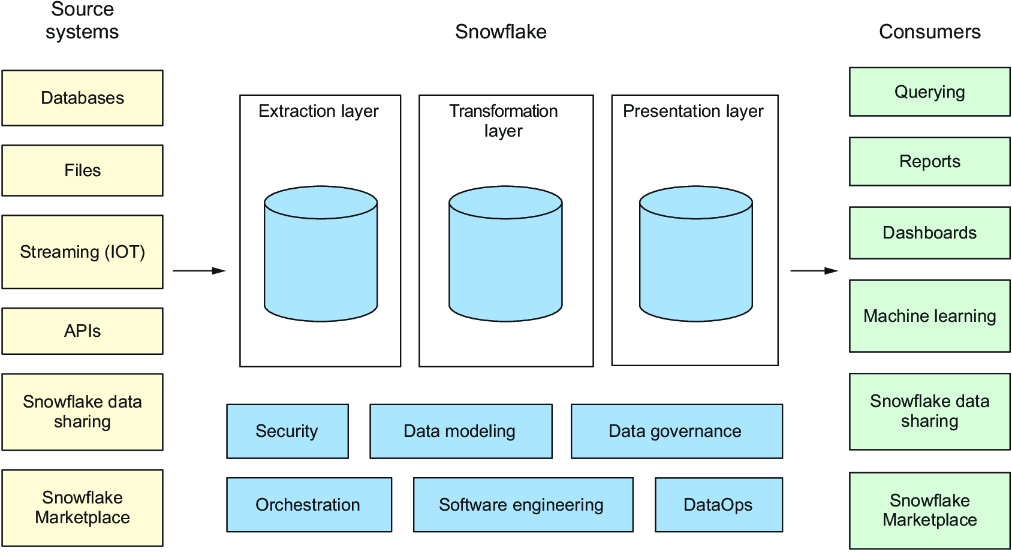
Use the pipeline-component figure to place governance beside security, data modeling, orchestration, software engineering, and DataOps across the Snowflake delivery flow. section 1.2









