Do you trust your government to do the right thing with your data? That question sits beside a broader one: whether public institutions act in people’s interests. In the United States, the share saying they trusted the federal government nearly always or most of the time fell from 77% in 1964 to 36% within a decade. Trust also varies with economic conditions and alignment with the governing party. section 4.3
Government has a role that companies cannot fill on their own: initiating laws and regulations at the scale needed to change how data is governed. That matters when online and mobile services have strong incentives to collect data, even if you adjust your privacy settings. section 4.7 section 5.13
Governmental Open Data offers a different use of public authority: making useful public information available while protecting sensitive information.
- Data about jobs, roads, internet access, building permits, and school lunches can help improve services and create economic value. section 6.5.4
- Personal and identity data, national-security and military information, and data that could disadvantage people or groups are outside this account of governmental Open Data. section 6.5.4
- Making Open Data widespread also calls for laws and regulations that encourage its use across sectors. section 6.5.4
Figure 6.1 Government can serve as an Open Data provider, catalyst, user, and policy maker to create value and mitigate risks.20
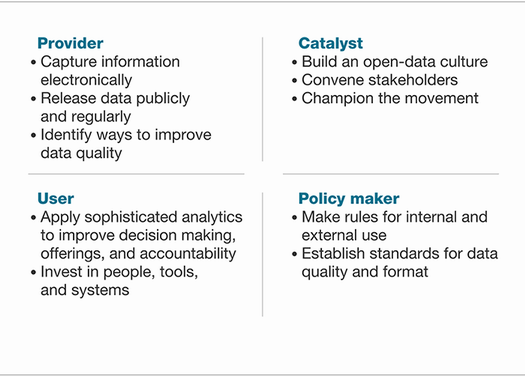
The figure brings together government's roles as an Open Data provider, catalyst, user, and policy maker—roles intended to create value while mitigating risks. section 6.5.4
The practical question is not simply whether government should handle data. Ask what it should make available, what it should protect, and whether its rules can earn public trust. section 4.3 section 6.5.4
