A graph schema specifies the node labels, relationship types, properties, and structural choices permitted in a graph. It grows iteratively as modeling decisions accumulate and may change to support important queries. section 2.3.4 section 2.4.4
Represent an LPG graph schema by:
- Drawing one node for each node label, then attaching properties and optionally showing example values or data types. section 2.3.4
- Drawing relationships between label nodes; relationships between the same label appear as self-loops. section 2.3.4
- Reading direction and constraints carefully, because no agreed visualization convention indicates semantic direction, optional properties, or unique identifiers. section 2.3.4
- Leaving inferred relationships out until the assumptions behind their instantiation are established. section 2.4.4
Twitter network schema
A final Twitter graph schema can contain four node labels—users, tweets, hashtags, and links—and six relationship types. Direct relationships may later represent transformations such as user amplification inferred from tweet retweets, but those inferred edges remain outside the initial schema. section 2.4.4
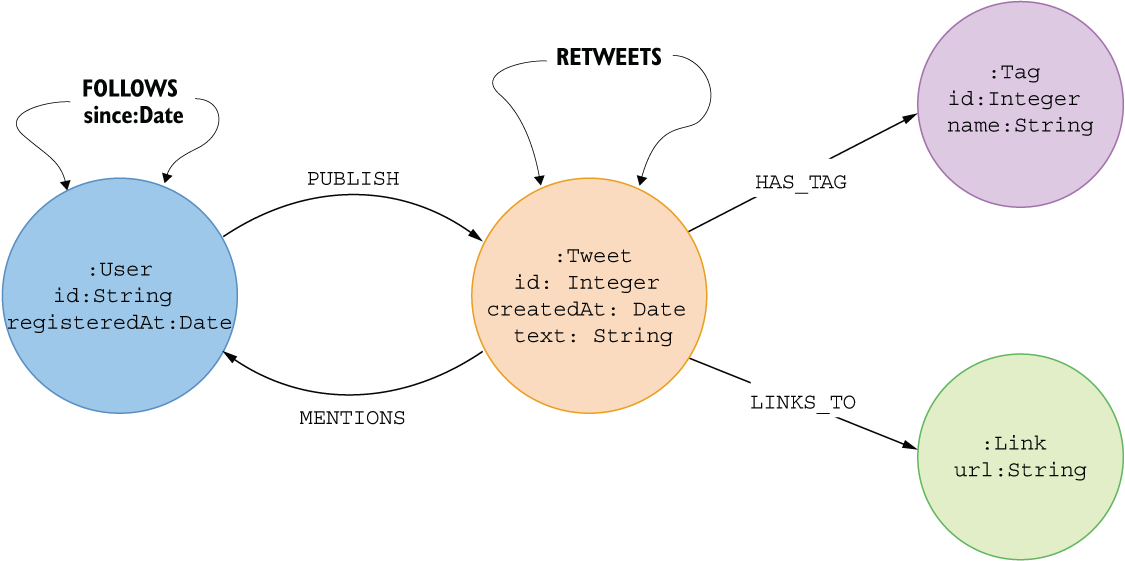
Inspect the final Twitter schema representation to see how node labels and relationship types combine into a complete graph design. section 2.4.4

