GraphRAG is a retrieval-augmented generation approach that traverses a knowledge graph to supply an LLM with external context. The graph represents entities as nodes and explicit relationships as labeled edges, preserving connections that may be lost when retrieval treats knowledge as isolated text chunks. section 3.11 section 3.3
A typical GraphRAG system has separate construction and generation pipelines:
- Construct the graph. Load external data, extract entities and relationships, resolve aliases that refer to the same entity, and store the resulting nodes and edges in a graph database. section 3.3.2
- Retrieve and generate. Analyze the query for entities and relationship types, resolve ambiguous terms, and traverse the graph to select interconnected context for the LLM. section 3.3.2
- Optionally use semantic search as an entry point. A vector index alongside the graph can locate starting nodes by similarity; traversal then follows their relationships. section 3.3.2
Product dependencies
For “What are the dependencies of the product manufactured by Acme Corp?”, query analysis can identify Acme Corp as a starting entity and “manufactures” and “dependencies” as relevant relationships. Graph navigation can then retrieve connected context for the answer. section 3.3.2
Figure 3.2 Graph RAG architecture: external data is transformed into a knowledge graph via information extraction. During retrieval, the user’s query drives a graph traversal to fetch interconnected context for the LLM
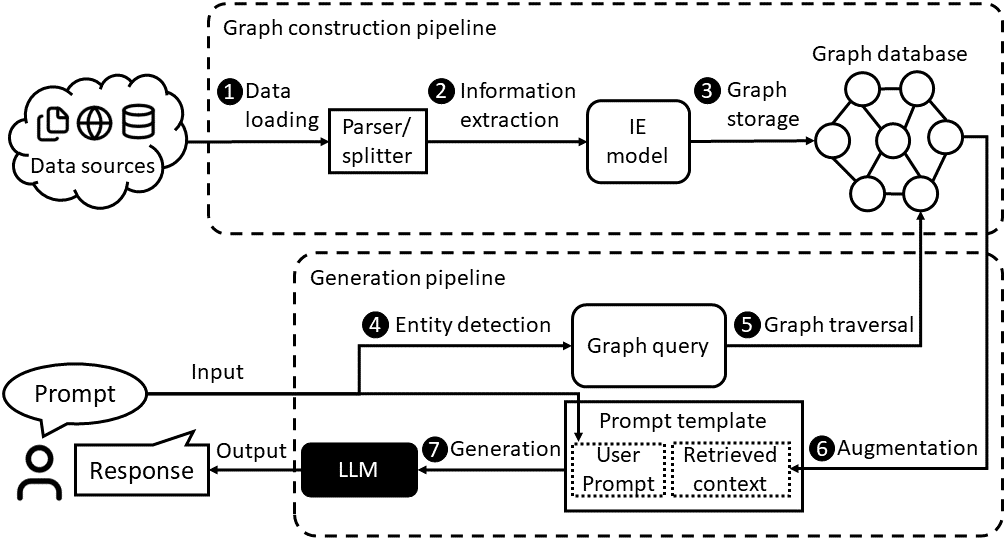
Follow the flow from external data and information extraction to graph traversal and LLM context. section 3.3.2
Graph structure adds construction work, and extraction errors can propagate into retrieval. Grounding also depends on source quality, ranking, permissions, and prompt assembly. Start with the least elaborate approach that fits the corpus, and use retrieval evaluation to identify failures that justify more complexity. section 3.3.2 section 3.11






