What if “I’m not creative” really means “not yet”? A growth mindset treats talent and ability as malleable: they can grow through effort and practice. Its opposite, a fixed mindset, treats traits as settled facts—either you have creativity or you do not. These are not permanent labels; a person may hold different mindsets in different domains. section 6.2.1
For programming, this perspective turns curiosity into a reason to continue rather than a test of innate talent. It supports learning unfamiliar techniques, recovering from failed attempts, and treating creative skill as something that can be cultivated alongside technical skill. section 6.2 section 6.2.4
A growth-oriented response to difficult work can involve:
- Meet challenges instead of avoiding them, including work beyond familiar languages, projects, or disciplines. section 6.2.3
- Use setbacks and effort as part of progress toward mastery rather than proof of inability. section 6.2.4
- Receive criticism as feedback that can improve the next attempt, even when it stings. section 6.2.1
- Let other people’s success supply ideas and inspiration rather than envy or threat. section 6.2.4
- Persist deliberately, while recognizing that willpower and talent remain contextual limits rather than magic ingredients. section 6.3.1 section 6.3.2
Leaving familiar code territory
In an open programming assignment, more creative student projects often came from exploring beyond taught techniques, with initial fumbling and failure followed by a more original design. The trade-off matters: the more creative projects also showed more clean-code issues in static analysis. Growth means experimenting, then taking responsibility for the quality consequences—not pretending that novelty automatically makes code better. section 6.2.3
This is a habit of interpretation, not a one-time motivational slogan. Changing from “I cannot do this” to “I can learn this” asks for repeated self-control, especially after negative feedback or a draining day. Habits, goals, and fewer unnecessary decisions can preserve effort for the work that matters. section 6.3.2
A growth mindset is closely tied to creative practice because creative work repeatedly requires challenge, feedback, persistence, and new connections. It does not claim that ability is irrelevant: innate factors may still affect potential. The useful shift is refusing to let a current limit become a final verdict. section 6.2.4 section 6.3.1
Figure 6.3 Fixed and growth mindsets. Would you rather buy a padlock to protect (limiting) or get fertilizer to grow (freedom)?
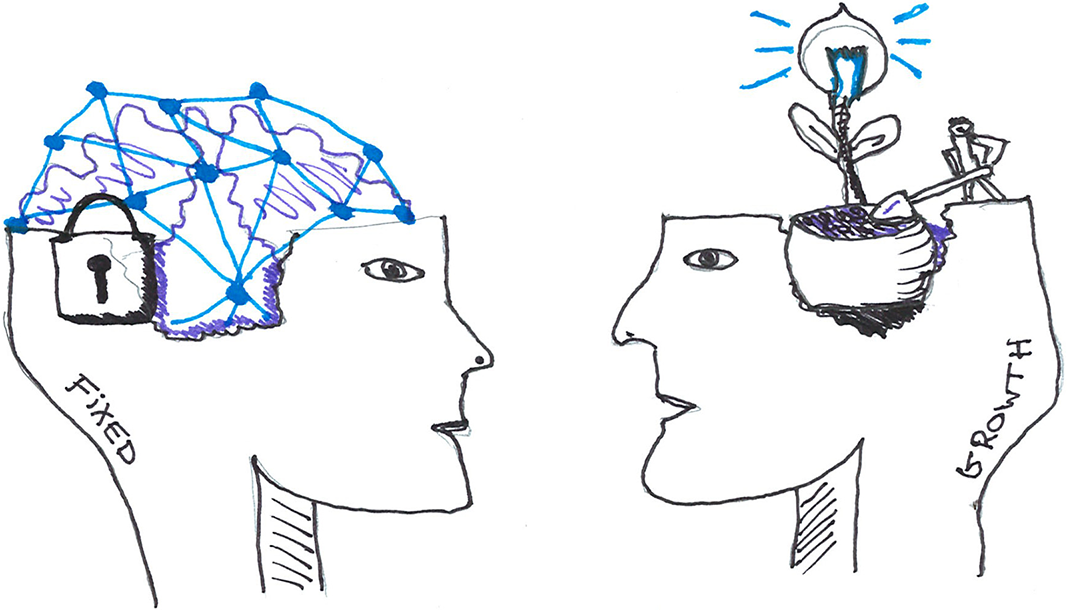
Use the padlock-and-fertilizer image as a quick prompt: are you protecting a fixed identity, or feeding a skill you want to grow? section 6.2.1


