An agent can give a poor answer even when its underlying model stays the same. The prompt, tool access, or software running its task loop may be the part that needs work. An agent harness is that supporting software: the scaffolding around the model that helps an agent perform tasks. An agent is the task-performing system formed by a model running within a configured harness; a harness can also contain multiple agents. section 1.1.1 section 1.1.2
Figure 1.1 The harness and the agent shows the boundary and purpose for the harness with respect to the agent worker.
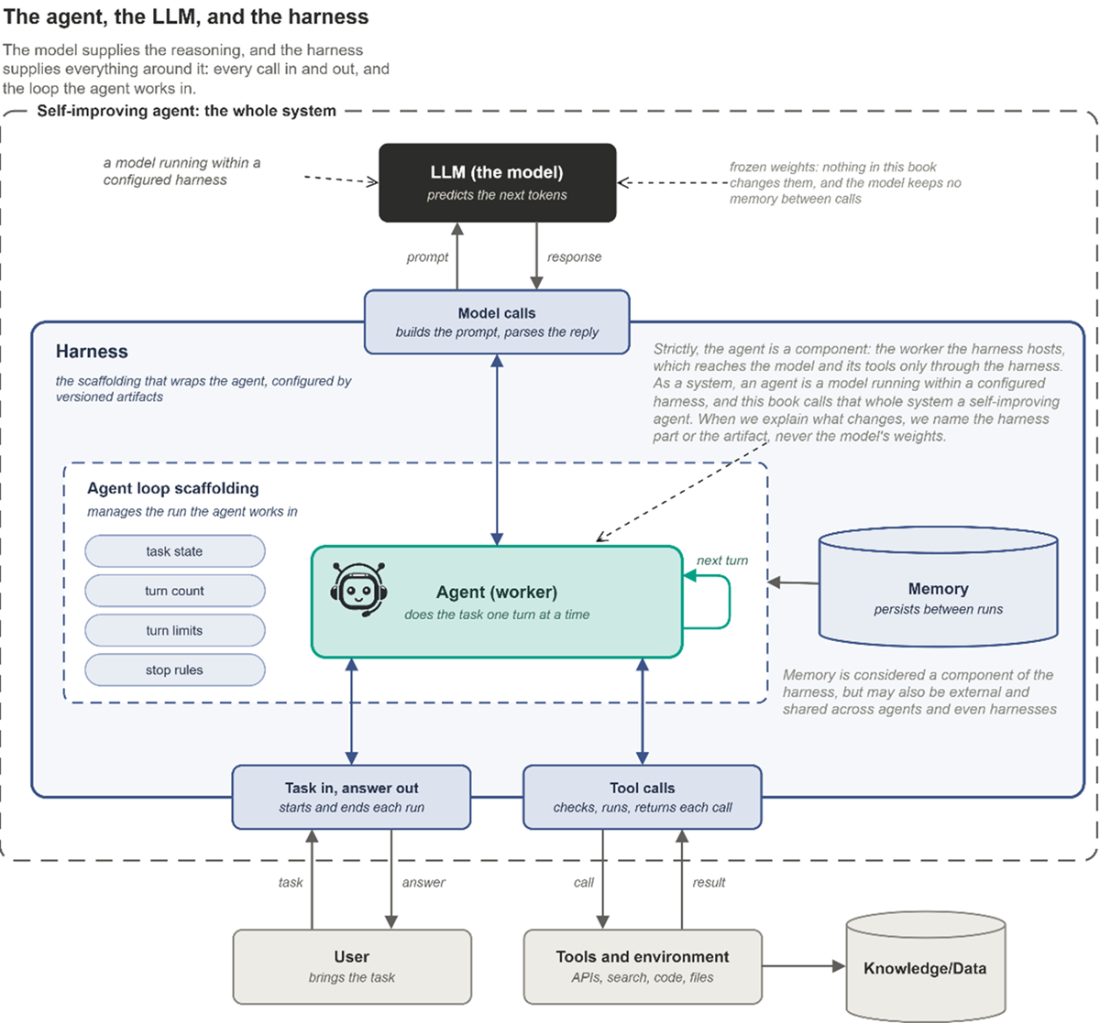
The diagram locates the harness around the agent worker and shows its relationship to the LLM and tool calls. section 1.1.1
The harness is also a place to improve an agent without changing model weights. Its editable infrastructure includes text, memory, metacognitive scaffolds, and code or tools. A self-improvement loop acts, measures a signal, searches for a better variant, and applies it. Measuring alone is not improvement: a candidate change still needs evaluation and an apply step. Changes can be versioned and rolled back; offline improvements pass through deployment review. section 1.5 section 1.1.3
One edit, many running instances
Imagine a thousand support conversations, each handled by an agent instance using the same frozen model and shared prompt. Edit one sentence of that prompt. On their next requests, the instances use the revised instruction; none has learned through a weight update. The change lives in shared infrastructure, so its effect should be checked before treating it as an improvement. section 1.1.3 section 1.5