A heuristic is a simple rule for making a quick decision. It draws on experience and knowledge when a group needs to move forward without time for deep analysis. In collaborative modeling, heuristics turn uncertainty into a conscious next action: place a boundary, split a discussion, surface another perspective, or test an assumption. section 3.2 section 3.2.1
Use heuristics as enabling constraints, not fixed instructions. A useful rule can make a facilitator more secure in an uncomfortable moment, but every group and session needs adjustment. Start by following a shared heuristic closely, then adapt it through observation, trial and error, and reflection. section 3.2 section 3.2.3
Build and apply a personal heuristic toolkit:
- Before a session, select one or two heuristics to practice rather than trying to use many at once. section 3.2.3
- Afterward, record decisions, group dynamics, and what maintained or disrupted flow; generalize recurring observations into rules. section 3.2.3
- Make assumptions, questions, and conflicts visible, then extract the implicit rules behind design suggestions. section 3.4
- Treat a decision as action: a rule only helps when the group uses it to choose and proceed. section 3.2.1
Balancing speed with minority wisdom
In a large Big Picture EventStorming group, “create different groups between pivotal events” improves progress, while “add minority wisdom to the group” improves completeness and safety. Rather than choosing one permanently, split into groups and reconvene about every 30 minutes to review the timeline centrally, asking who can relate to what was discussed. Competing heuristics can produce a more nuanced rule through repeated experience. section 3.2.2
Heuristics can drive design as well as facilitation. “Find the natural boundaries in the domain” is a high-level design heuristic supported by more concrete prompts: split according to language, departments, or actors. These rules give an initial boundary proposal, which later design activities can refine. section 3.3.1 section 3.5
Figure 3.4 BigScreen’s natural boundaries. We picked one of our heuristics from our intuition starters kit and applied it to the EventStorm, creating two bounded contexts: Movie Scheduling and Ticket Purchasing. This way, we have a starting point to dig deeper with other design activities.
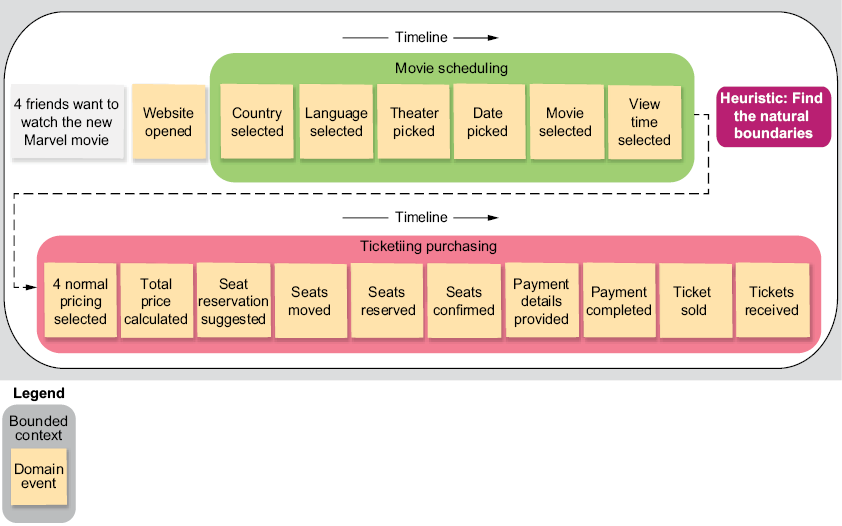
Use the boundary view to see how applying one heuristic to an EventStorm produces an initial pair of bounded contexts for further investigation. section 3.3.1
Quick rules are not guarantees. Several valid heuristics may point in different directions, and mental shortcuts can sometimes hinder judgment. Make tradeoffs discussable, invite alternative perspectives, and use feedback loops to gather information and adjust the model rather than treating an early choice as final. section 3.2.2 section 11.3.1 section 7.0








