High-frequency trading (HFT) is an advanced form of automated trading: algorithms execute large volumes of orders in fractions of a second to capture tiny price inefficiencies or arbitrage opportunities. Speed, algorithmic sophistication, and infrastructure—not merely a trading rule—determine competitiveness. section 1.3.3 section 11.4.1
HFT depends on several tightly coupled capabilities:
- Low-latency systems and powerful computers reduce the time between detecting and executing an opportunity. section 11.4.1
- High order volume turns minute price movements or liquidity provision into repeated opportunities. section 11.4.1
- Co-location near stock exchanges can provide an execution advantage over slower competitors. section 11.4.1
- Operational risk remains constant, and ordinary Python libraries may be too slow for competitive performance. section 11.4.1
A fleeting price difference
An HFT system can detect a small price discrepancy or arbitrage opportunity, submit trades within microseconds, and repeat the process thousands of times daily. This differs from ordinary automated trading, which can execute a predefined strategy without competing at such extreme speeds. section 1.3.3 section 11.4.1
Figure 11.4 On an exchange, sellers and buyers can interact directly. A broker is an entity between a buyer and a seller. A broker usually facilitates trading on one or more exchanges.
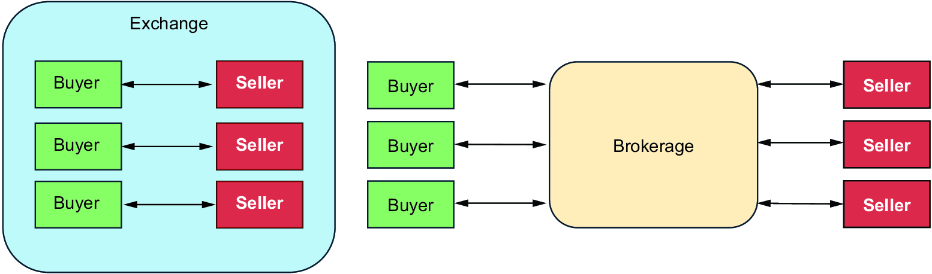
Use the exchange-versus-broker diagram to distinguish direct interaction between buyers and sellers from broker-mediated access, an important part of HFT infrastructure. section 11.4.1
