An HSRP hello message is a multicast control message sent periodically by routers in an HSRP group. It establishes and maintains neighbor relationships so routers can coordinate an active router and standby routers for a redundant default gateway. section 19.1.2 section 19.4
Hello messages support several operational behaviors:
- Routers use them to elect one active router and one or more standby routers. section 19.1.2
- If a router stops receiving hellos from a neighbor, it assumes that neighbor has failed and can take over the default-gateway role. section 19.1.2
- Multicast limits unnecessary host processing: switches flood the messages, but non-HSRP hosts ignore their contents. section 19.1.2
- HSRPv1 uses multicast IP address 224.0.0.2, while HSRPv2 uses 224.0.0.102. section 19.4
Two-router HSRP group
R1 and R2 share a virtual IP address but retain unique interface addresses. R1 sources its HSRP hellos from 10.0.0.2, while R2 uses 10.0.0.3. With matching group and virtual-IP settings, the routers exchange hellos; R1 can become active and R2 standby. If R1 fails, R2 takes over. section 19.3 section 19.1.2
Figure 19.3 R1 and R2 communicate with multicast hello messages to establish and maintain their FHRP neighbor relationship. R1 becomes the active router, and R2, the standby. When a host sends an ARP request to the VIP, R1 will reply with the virtual MAC address, allowing the host to create an appropriate ARP table entry. Switches will also learn the virtual MAC address on the appropriate port.
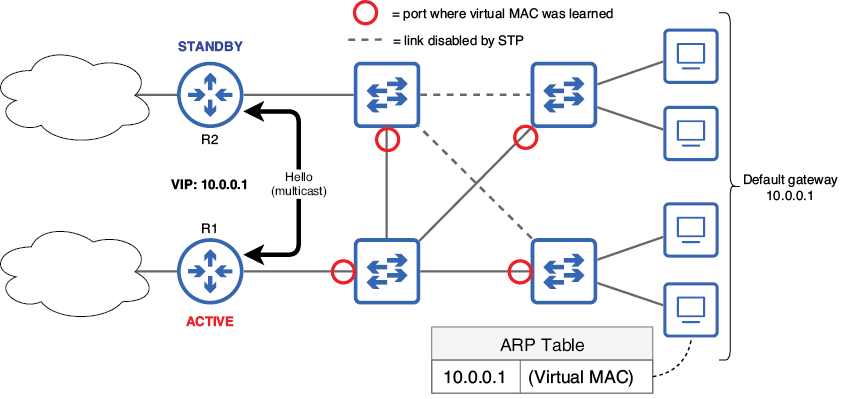
View the LAN scenario showing multicast hello exchange, active and standby roles, and the virtual MAC address used for the virtual IP. section 19.1.2
