An OSPF hello message is a control message that routers send regularly to discover neighboring OSPF routers and maintain established neighbor relationships. Hello messages include the local router ID and known neighbor router IDs, and use multicast address 224.0.0.5 so OSPF-enabled routers on the segment can receive them. section 18.3.1
Key operational points:
- OSPF-enabled interfaces send hello messages; interfaces without neighboring routers waste resources and may expose network information. section 18.2.3
- On broadcast and point-to-point networks, the default hello interval is 10 seconds and the dead interval is 40 seconds. section 18.3.2
- If no hello arrives before the dead timer expires, OSPF removes the neighbor; a physical link failure removes it immediately. section 18.3.2
- A received hello begins neighbor-state processing: an entry can move from Down to Init, 2-Way, and eventually toward full adjacency when applicable. section 18.3.1
Checking a neighbor
After R2 receives a hello from R1, the command `show ip ospf neighbor` displays R1 in the neighbor table. An Init state means R2 received R1’s hello, but the hello did not list R2’s router ID. In a broadcast network, routers may remain 2-Way as DROthers, while DR and BDR relationships proceed to full adjacency. section 18.3.1 section 18.3.2
Figure 18.10 An OSPF hello message from R1 is addressed to multicast address 224.0.0.5. The switch floods the frame, and OSPF-enabled R2 G0/0 and R4 G0/0 accept the hello message. R3 ignores the hello because G0/0 is not OSPF-enabled.
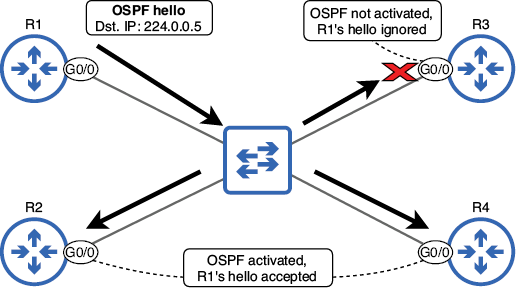
Use the segment diagram to trace how a hello addressed to 224.0.0.5 reaches OSPF-enabled routers while other hosts ignore it. section 18.3.1
