HTTP is the application-layer protocol used to exchange requests and responses across networks.
HTTP is the dependable, widely understood foundation for web services and a practical way for microservices to communicate directly. section 5.7.1section 5.0
Use HTTP when a service needs to send a message and receive the result immediately:
Send an HTTP POST request from one microservice directly to another. section 5.7
Use the direct response to determine immediately whether message handling succeeded or failed. section 5.7
Build REST APIs with support available across programming languages and extensive learning resources. section 5.7.1
Direct service-to-service messaging
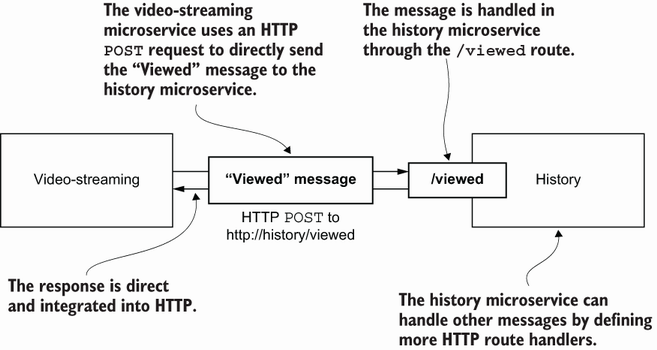
A video-streaming microservice sends an HTTP POST request directly to a history microservice. The explicitly targeted recipient handles the message and returns a direct response. section 5.7
Figure 5.7 An HTTP POST request explicitly targets another microservice by name.
Shows how an HTTP POST request explicitly targets another microservice by name. section 5.7
How Bootstrapping Microservices, Second Edition: With Docker, Kubernetes, GitHub Actions, and Terraform covers it
How deep it goes
Explains HTTP as a web-service foundation and demonstrates direct POST messaging, but defers protocol internals.
Examples
Uses a video-streaming service sending an HTTP POST message directly to a history service.
What you can do after
Apply HTTP to send direct messages between microservices and assess success from immediate responses.
How it connects
Connects HTTP with microservices, REST APIs, RabbitMQ, Docker Compose, and application deployment.
The Design of Web APIs, Second EditionHTTP is the Hypertext Transfer Protocol, a standardized synchronous request–response protocol for exchanging resources and messages between clients and servers.
Building Web APIs with ASP.NET CoreHTTP is the stateless application-layer protocol used to transfer web resources and messages between clients and servers.
Rust Servers, Services, and AppsThe Hypertext Transfer Protocol is an application-layer protocol for transferring resources and messages over networks.
Build Python Web Apps with StreamlitHTTP is the application-layer protocol used to transfer web resources and exchange messages between clients and servers.
RESTused by · REST is an architectural style for distributed hypermedia systems that organizes interactions around resources and representations through constraints including a uniform interface, stateless communication, cacheability, and layered components.
contractused by · An API contract is a specification of the operations, data, and behavioral expectations that govern interactions between software components.
HTTPScontrasts with · HTTPS is HTTP carried over TLS, which provides encryption and endpoint authentication for network communication.
TCPuses · TCP is a connection-oriented transport-layer protocol that provides reliable, ordered delivery of byte streams between network endpoints.
web serviceused by · A web service is a programmatic software interface that exposes functionality or data through web technologies or network protocols, typically HTTP.
protocolkind of · A protocol is a defined set of rules and conventions governing communication or interaction among systems, components, or participants.
This explainer was generated by Manning's knowledge graph from the text of Bootstrapping Microservices, Second Edition: With Docker, Kubernetes, GitHub Actions, and Terraform. The section links point to the parts of the book it draws on.