HTTP is the application-layer protocol most commonly used by web services and web applications to communicate with the outside world. Its simplicity and universality make it the interface between distributed application components and browsers or other clients. section 1.1
HTTP can be learned from the network boundary upward: TCP carries raw byte streams, a conversion layer models HTTP messages, and a server maps requests to responses. REST, gRPC, and WebSockets build communication techniques around HTTP and TCP. section 2.0
A practical Rust progression uses HTTP to build increasingly useful services:
- Build a basic HTTP server with the Rust standard library, serving static pages and JSON data. section 2.0
- Test requests and responses with cURL and a web browser. section 2.0
- Expose REST APIs through Actix routes, handlers, request extractors, HttpResponse, and application state. section 3.0 section 3.3
HTTP request flow in Actix
A client sends a RESTful API request over HTTP to an Actix HttpServer listening on a port. The application selects a route by path and HTTP method, invokes its handler, and returns an HttpResponse. section 3.3
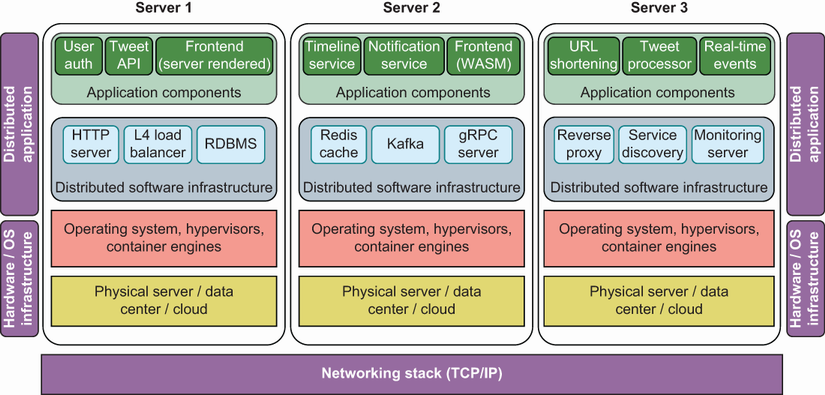
Use the distributed-systems stack to place HTTP between web applications and the underlying networking, operating-system, and hardware infrastructure. section 1.1







