liveBook · Manning

HTTPS

As explained in Acing the CCNA Exam: Volume 1 Fundamentals and Protocols

HTTPS is a protocol for transferring web resources over HTTP with protection provided by TLS.

HTTPS transfers web resources over HTTP with protection provided by TLS. It is a Layer 7 application protocol used by web browsers and web servers. section 4.3.1

A browser request using HTTPS involves several networking layers:

  • Addresses the web server’s HTTPS service at Layer 4 port 443. section 4.3.1
  • Uses TCP to check that messages reach their destination. section 4.3.1
  • Relies on Layers 2 and 3 to deliver the message hop by hop and end to end. section 4.3.1
Figure 4.1 A web browser on PC1 uses a Layer 7 protocol (HTTPS) to request a web page from the web server on SRV1. Layers 2, 3, and 4 work together to deliver the message to the appropriate application on SRV1. Layer 1 is the medium over which the communication occurs.
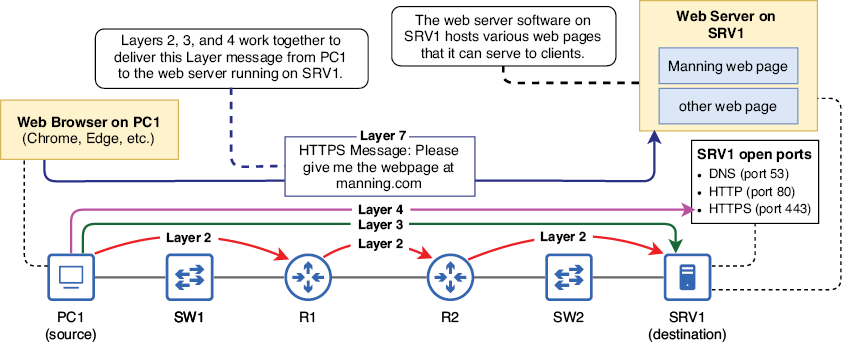
Trace a browser request from PC1 to the web server on SRV1 through Layers 1–4. section 4.3.1


How Acing the CCNA Exam: Volume 1 Fundamentals and Protocols covers it

How deep it goes
Identifies HTTPS as a Layer 7 protocol, its TCP relationship, and port 443, but does not explain TLS internals.
Examples
Uses a browser request from PC1 to SRV1 and a server with open ports 53, 80, and 443.
What it assumes
Assumes basic awareness of TCP/IP layers while distinguishing application protocols from transport ports and physical device ports.
What you can do after
Evaluate HTTPS traffic by recognizing its application-layer role, TCP transport, and destination port 443.
How it connects
Connects HTTPS with HTTP, TLS, TCP, application-layer protocols, and the TCP/IP networking model.

Also explained in

Compare how 7 books explain HTTPS →

Related concepts

This explainer was generated by Manning's knowledge graph from the text of Acing the CCNA Exam: Volume 1 Fundamentals and Protocols. The section links point to the parts of the book it draws on.




