Hugging Face is an open-source AI platform for discovering, hosting, testing, downloading, and using machine learning models and datasets. It supports applications across natural language processing, computer vision, and audio, helping developers move from an AI problem to a working result without building models from scratch. section 1.0 section 1.4
Use the Hub to move from a task requirement to an executable model workflow:
- Search the Model Hub by task, architecture, language, or performance metric. section 1.4.2
- Inspect pretrained model repositories and test eligible models in the browser through the Hosted Inference API. section 1.2
- Generate Transformers usage examples from a model page or call models through simple HTTP requests. section 1.2
- Download individual files with huggingface_hub when local or offline execution requires controlled artifacts. section 2.3.1
- Pin downloads to a branch, pull request, tag, or commit hash through the revision parameter. section 2.3.1
Test an object-detection model
Open the facebook/detr-resnet-50 repository, upload an image to its Hosted Inference API widget, and inspect detected objects with their confidence levels. The model page also provides Transformers code for running the model in Python. section 1.2
Figure 1.2 Exploring the pretrained models hosted at Hugging Face Hub
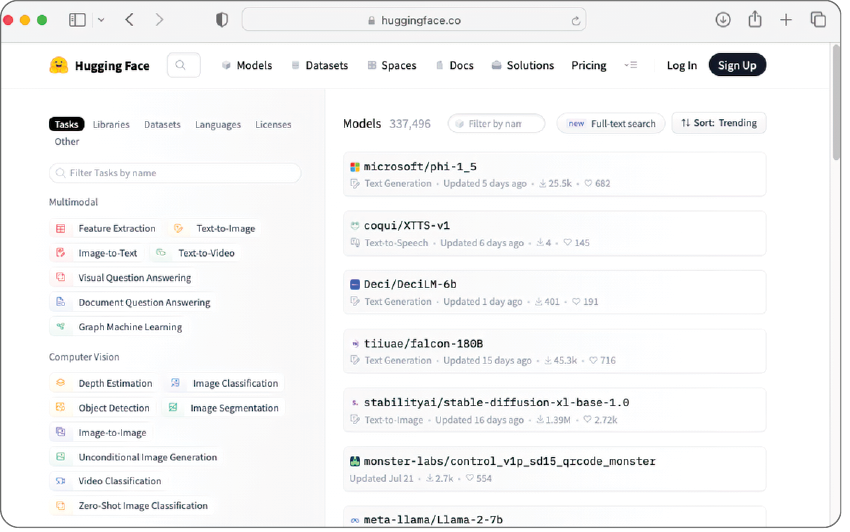
Use the Model Hub overview to visualize how pretrained model repositories are explored. section 1.2
from huggingface_hub import hf_hub_download

hf_hub_download(repo_id="google/pegasus-xsum",
                filename = "config.json")
Use the Python listing as a minimal pattern for downloading a repository file with huggingface_hub. section 2.3.1




