liveBook · Manning

Preference

As explained in Algorithms Every Programmer Should Know

A preference indicates which potential match a participant favors over another.

A preference ranks potential matches from most to least favored. Matching procedures use these rankings to guide proposals and choices. Preferences may also be inferred from signals such as likes, profile views, or activity. section 2.1.1 section 2.2.1

Student–university rankings

Universities rank students: X prefers Alice, Bob, then Carol; Y prefers Bob, Carol, then Alice. Students rank universities too, so each side’s preferences shape who proposes and which offers are accepted. section 2.1.1

Figure 2.2 The receiver's preference list is checked, where Alice prefers X, Bob prefers Y, and Carol prefers Z. Final matching is completed once all students accept the proposal.
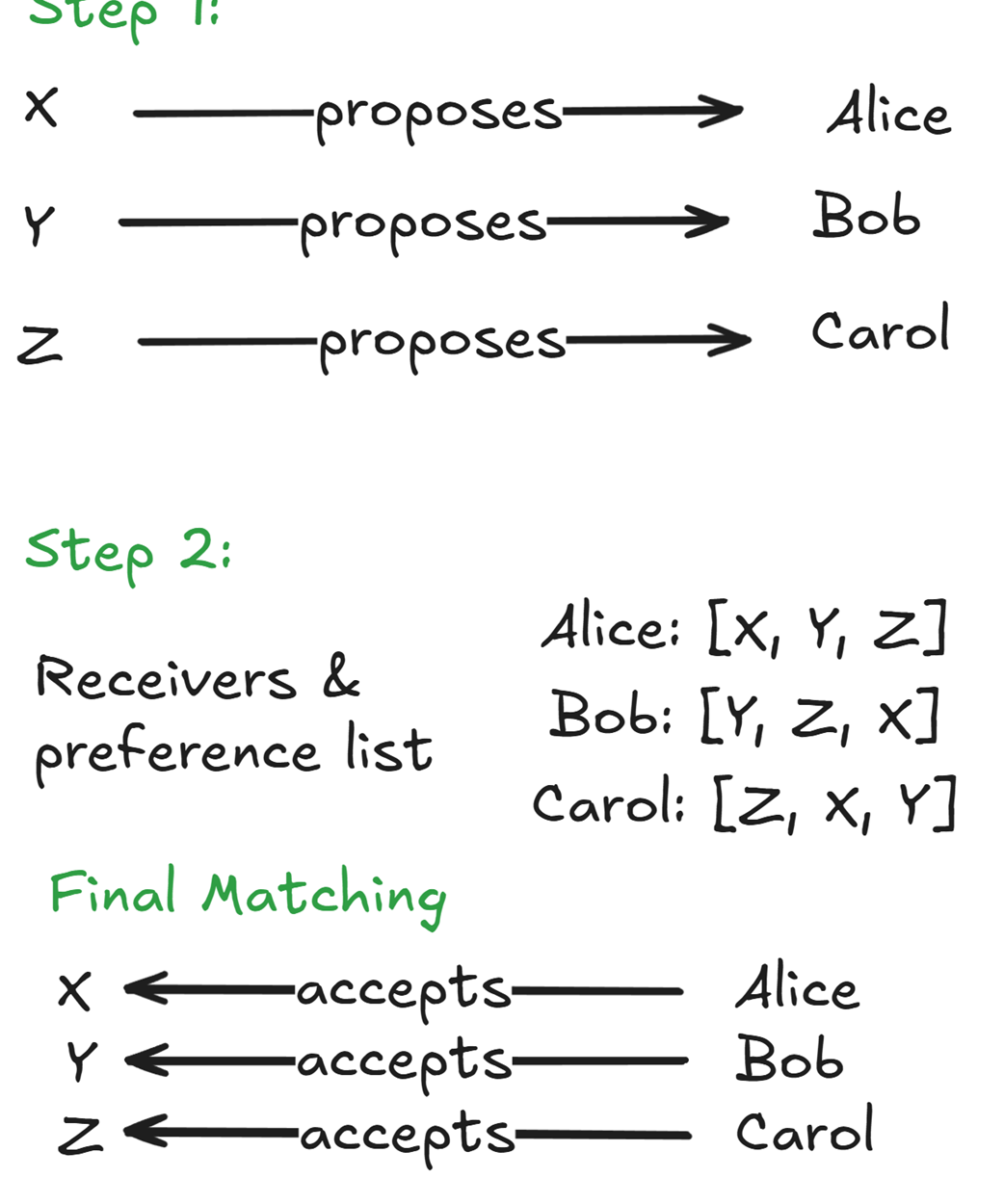
Follow how each receiver’s preference ranking is checked against incoming proposals. section 2.1.1


How Algorithms Every Programmer Should Know covers it

How deep it goes
Works through ranked lists in a matching example and notes explicit and inferred preferences in applications.
Examples
Uses student–university rankings and dating criteria to illustrate preferences.
What you can do after
Understand how ranked or inferred preferences shape proposals, acceptances, and matching choices.
How it connects
Connects preference rankings to stable matching, Gale–Shapley, and deferred acceptance.

Also explained in

Compare how 6 books explain preference →

Related concepts

This explainer was generated by Manning's knowledge graph from the text of Algorithms Every Programmer Should Know. The section links point to the parts of the book it draws on.



