Two people can follow the same accounts and still see different feeds. A recommender system personalizes what it shows, partly by drawing on each person’s past interactions. A preference is an inclination toward particular content or qualities—for example, wanting more posts from one account than another. section 7.5 section 4.2
Recommenders learn preferences indirectly. If someone engages more with account A than account B, the system may show more from A. But an interaction is only evidence of interest, not a complete account of what the person wants. Interests that have not surfaced may remain invisible. section 4.2
Figure 4.1 Recommender systems learn our preferences by observing our interactions with the items they present. There is no guarantee that all the preferences will be appropriately accounted for. In this figure, the user is a book lover, but the system is unaware of their preferences, and it’s reinforcing the known ones.
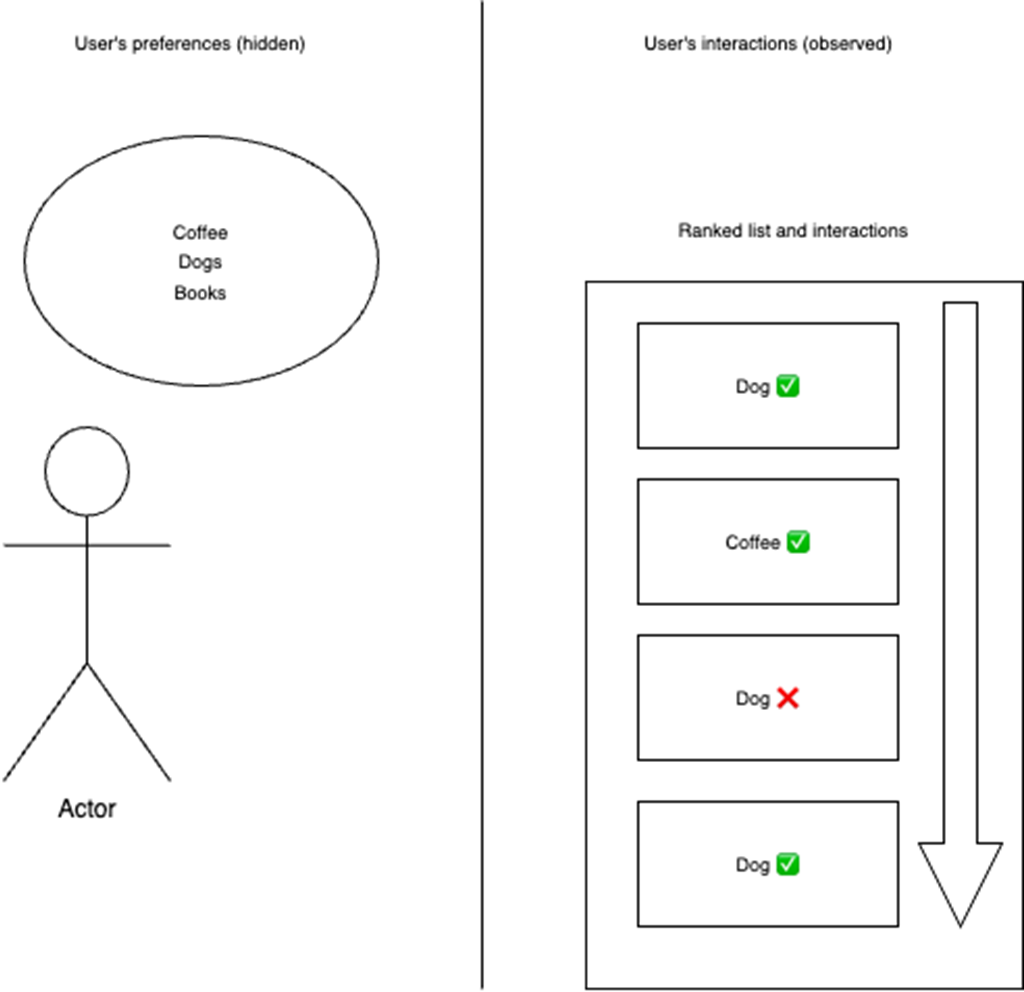
The figure illustrates how recommendations can reinforce known interests while overlooking a user’s interest in books. section 4.2
This creates an exploration-versus-exploitation dilemma. Showing more of what already gets a positive response can be valuable in the short term, but may miss other interests. Trying unfamiliar content can reveal those interests, though too much may annoy users. People differ in how much discovery they welcome. section 4.2
Measuring whether recommendations match preferences is difficult. Asking users to value every item would be burdensome, and judging a recommendation against every possible alternative is impractical. Platforms instead focus on quantities they can measure, making those quantities imperfect stand-ins for the value users receive. section 4.3
Preferences are also only one part of evaluating a recommender system. Recommendations distribute attention across content, raising questions about quality and fair allocation that do not have straightforward answers. section 4.0





