A hybrid conversational system combines classification, predefined response pairs, task-oriented dialogue flows, and generated responses. It keeps predictable paths for known needs while adding generative flexibility where fixed responses are insufficient. section 4.1.4
Generated responses can serve several roles:
- Act as a fallback when classification cannot predict an intent confidently. section 4.1.4
- Answer questions while retrieval-augmented generation grounds responses in current, verifiable domain information. section 4.1.4
- Personalize a greeting or summarize the user’s problem before a configured response or task flow. section 4.1.4
A safer conversational pattern
A user’s recognized request can launch a task flow with a preconfigured answer, while generated text acknowledges the specific situation. If intent recognition fails, generation may provide a response or route the user to fallback or escalation. section 4.1.4
Figure 4.4 Traditional classification models use supervised learning to predict one of several predefined classifications. They look for the intent, or meaning, of a user input. Generative models use decoding transformers to create a text completion. They predict the next sequence of tokens (loosely, words or characters) that are most likely to occur after the user input.
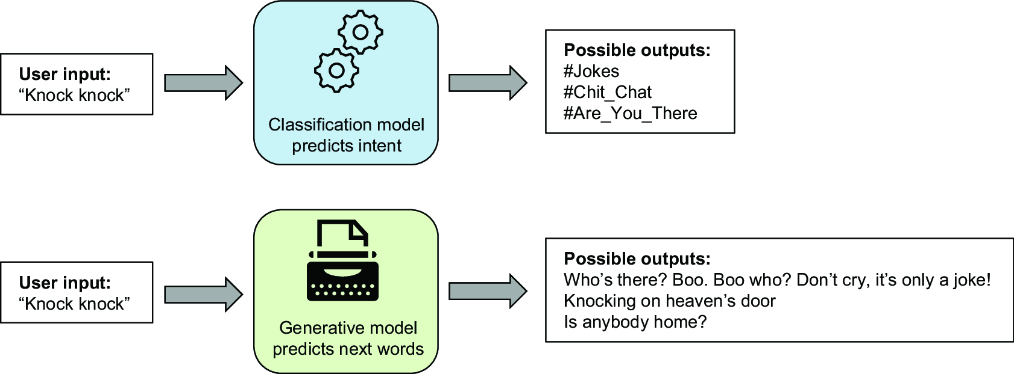
Compare intent classification, which selects among predefined meanings, with generative modeling, which predicts a likely continuation of the user’s input. section 4.1.4




