A hyperparameter is a configuration value chosen outside ordinary parameter learning that controls a model or learning procedure. Examples include the number of nearest neighbors, the number of K-means clusters, SVM kernel settings, regularization constants, and neural-network learning rates. Hyperparameters shape model behavior and influence whether learned models underfit, overfit, or generalize to unseen data. section 7.4 section 10.4
Tune hyperparameters by searching a multidimensional configuration space for strong validation performance:
- Grid search exhaustively evaluates specified combinations and works well for smaller spaces; logarithmic values can help identify the right order of magnitude. section 7.4
- Random search samples values from prior distributions, can find good configurations faster, and keeps its iteration budget independent of the number of parameters. section 7.4
- Bayesian optimization models generalization performance with a Gaussian process, then selects candidates using expected improvement or an upper confidence bound. section 7.4.1
Learning rate in stochastic gradient descent
The learning rate determines the size of each gradient step. Values that are too high can miss the optimum, while values that are too low prolong training. A practical strategy starts at 1e-3 and reduces the rate with a schedule; common momentum values include 0.5 and 0.9. section 10.4
Figure 7.12 Bayesian optimization algorithm
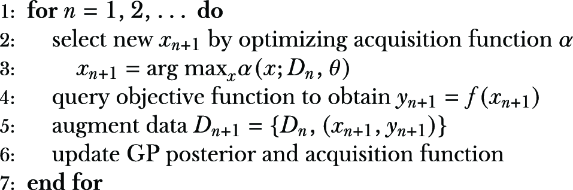
Use the algorithm figure to trace Bayesian optimization as it balances exploration and exploitation while incorporating previous objective evaluations. section 7.4.1


















