Hyperparameter tuning selects suitable values for an algorithm’s configurable parameters before execution. Parameters may also adapt during execution, helping balance exploration and exploitation. section 6.2.3
Tuning is especially important in metaheuristics, where parameter settings affect solution quality, runtime, cycling, stagnation, and whether a global optimum is found. section 6.2.3
Three tuning modes differ in what controls parameter updates:
- Deterministic tuning follows a fixed update rule without using search information. section 6.2.3
- Adaptive tuning uses information from the search to change a control parameter. section 6.2.3
- Self-adaptive tuning changes the update rule itself. section 6.2.3
Choosing tabu tenure
In tabu search, a tenure that is too short can cause repeated cycling and weak exploration. One that is too long can prohibit useful moves and cause stagnation. Testing values or dynamically controlling tenure helps manage this trade-off. section 6.2.3
Practical tuning commonly involves experimentation, sensitivity analysis, or a dedicated parameter-tuning technique. In particle swarm optimization, swarm size and neighborhood size expose similar trade-offs between exploration, exploitation, convergence speed, and computational complexity. section 9.2.3
Figure 6.6 Effect of tabu tenure
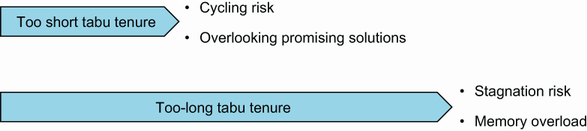
Compare how tabu-tenure choices affect search performance. section 6.2.3
Figure 6.7 Dynamically controlling the tabu tenure
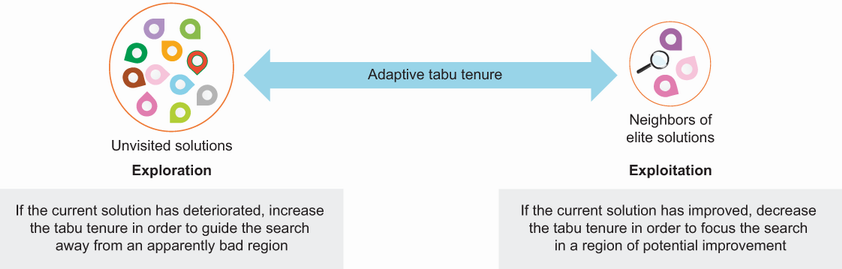
Examine dynamic control of tabu tenure during search. section 6.2.3

















