Infrastructure as a service (IaaS) provides computing, storage, and networking resources on demand. Customers use the provider’s infrastructure to create virtual machines, install operating systems, and run applications without purchasing or maintaining the underlying resources. section 17.3.2 section 17.4
IaaS is distinguished by the customer’s control of the software environment and by cloud delivery characteristics:
- Uses on-demand self-service, broad network access, pooled resources, rapid elasticity, and measured service. section 17.4
- Lets customers scale resources up or down quickly and generally pay according to measured usage. section 17.4
- Provides more infrastructure control than PaaS, while SaaS delivers completed applications instead of customer-managed virtual machines and operating systems. section 17.3.2 section 17.4
Operational scenario
An organization obtains servers, storage, and networking from AWS, Microsoft Azure, or GCP, creates virtual machines, installs operating systems, and runs its applications on the provider’s infrastructure. section 17.3.2 section 17.4
Figure 17.14 The spectrum of what is offered in each cloud service model in comparison to colocation and on-prem solutions
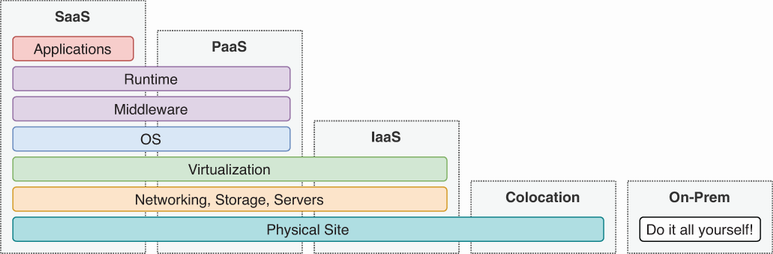
Compare IaaS with PaaS, SaaS, colocation, and on-premises solutions by the resources supplied and the responsibilities retained by the customer. section 17.3.2



