liveBook · Manning

Identity element

As explained in Elliptic Curve Cryptography for Developers

An identity element is an element that leaves another element unchanged under a specified operation, such as zero for addition or one for multiplication.

An identity element leaves another element unchanged under a specified operation. For addition, zero satisfies a + 0 = a; for multiplication, one satisfies b × 1 = b. section 2.1

The identity element changes with the algebraic setting:

  • Addition uses 0, because adding it preserves the original element. section 2.1
  • Multiplication uses 1, because multiplying by it preserves the original element. section 2.1
  • Elliptic-curve point addition uses the point at infinity, written 0 here; P + 0 = P and P − P = 0. section 3.1
  • Taking the order of a point reaches the point-at-infinity identity, while taking an mth root of unity to the mth power reaches 1. section 15.1

Clock arithmetic and elliptic curves

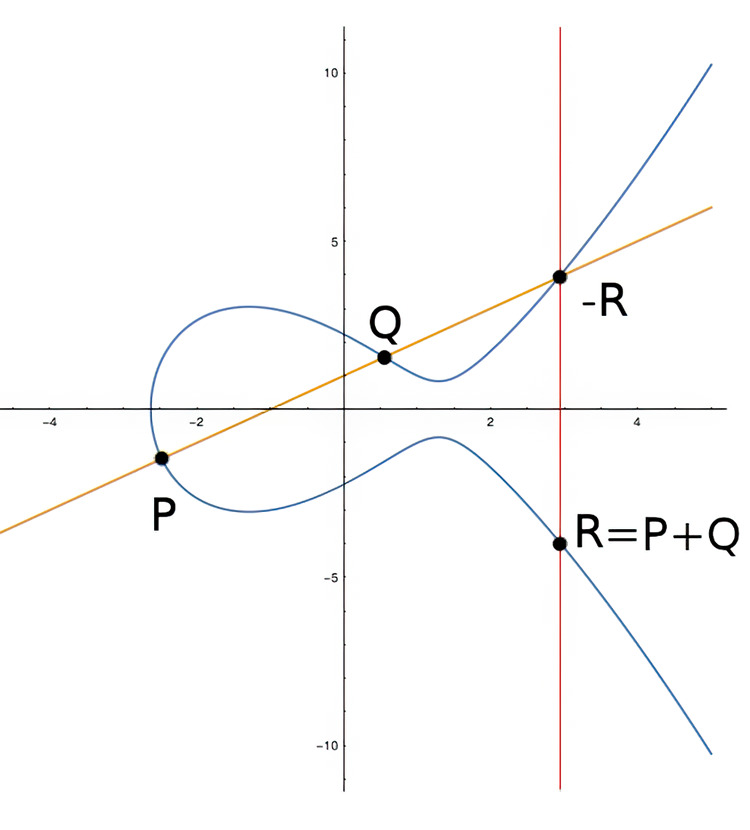
A clock illustrates modular arithmetic: values wrap around after the modulus, so 15 is congruent to 3 modulo 12. On an elliptic curve, adding a point to its inverse produces the point at infinity rather than an ordinary plotted point. section 2.1 section 3.1

Figure 3.1 Elliptic curve \(y^2=x^3-5 x +5\)
figure

Visualizes the elliptic curve whose point-at-infinity identity supports point addition. section 3.1

How Elliptic Curve Cryptography for Developers covers it

How deep it goes
Defines additive and multiplicative identities, then treats the elliptic-curve point at infinity as a special computational case.
Examples
Uses zero, one, modular clock arithmetic, the point at infinity, and roots of unity as concrete examples.
What it assumes
Builds from ordinary addition, multiplication, inverses, and clock-style modular arithmetic before introducing elliptic-curve identities.
What you can do after
Evaluate/understand why arithmetic systems require neutral elements and how elliptic-curve code represents its special identity.
How it connects
Connects identity elements with finite fields, inverses, elliptic curves, point orders, roots of unity, and pairings.

Also explained in

Compare how 5 books explain identity element →

Related concepts

This explainer was generated by Manning's knowledge graph from the text of Elliptic Curve Cryptography for Developers. The section links point to the parts of the book it draws on.