An identity element leaves another element unchanged when combined under a group’s operation. In multiplication, 1 is the identity because a × 1 = a. In elliptic-curve addition, the point at infinity, written O, plays the same role: P + O = P. section 5.2.1 section 5.3.1
Recognize the identity element by checking these behaviors:
- It belongs to the set used by the operation. section 5.2.1
- Combining it with any group element does not change that element. section 5.2.1
- Its appearance depends on the operation: multiplication uses 1, while elliptic-curve addition uses O. section 5.3.1
- In subgroup checks, raising a received public key to the subgroup order should produce the identity element when membership is valid. section 5.4
Elliptic-curve edge case
When elliptic-curve geometry produces no ordinary intersection point, define the result as the point at infinity O. This makes addition complete: O + O = O and P + O = P. section 5.3.1
Figure 5.4 The four properties of a group: closure, associativity, identity element, and inverse element.
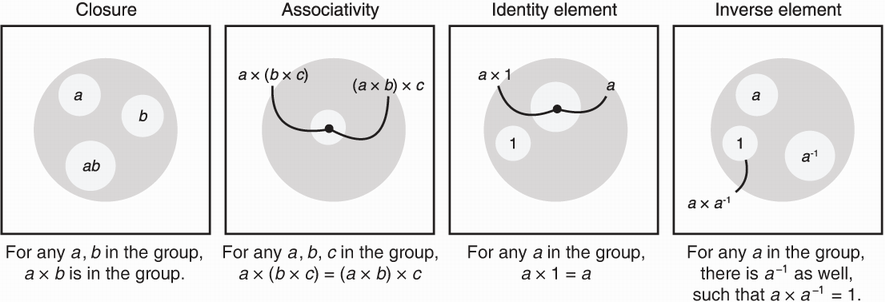
Use the group-properties diagram to compare the identity element with closure, associativity, and inverse elements. section 5.2.1




