An implementation gap is a mismatch between intended behavior or design and what the implementation delivers. Review or testing may reveal a missing failure path, an imprecise response, a violated architectural boundary, or a feature declared complete without evidence. In specification-driven development, the gap is also feedback about how intent traveled from the human decision to the specification, implementation, and validation. section 3.1 section 3.2.5
A link feature with an unanswered question
Suppose links expire after a fixed duration. The specification states the duration but never says what happens when someone visits an expired link. An agent must choose that behavior without guidance. If review exposes the omission, specifying the failure path is more durable than adding a branch only in code: the next change can then recover the decision from the specification. The same issue arises when a malformed URL receives an error, but the specification says only “return an error for invalid input” rather than recording the intended status and user-facing message. section 3.2 section 3.1
Attribute a gap to the point where intent was lost, then repair that part of the workflow:
- Surfacing: a needed behavior was never elicited. Add the missing question to the authoring dialogue. section 3.4.1
- Capture: the decision was discussed but recorded too vaguely. Strengthen the specification format. section 3.4.1
- Construction: behavior works, but the implementation violates an intended design boundary. Strengthen standing constraints or structural checks. section 3.4.1
- Verification: completion was accepted despite a failure found in review or testing. Require repeatable evidence, such as tests or contract checks. section 3.4.1
Correct the current specification before treating the feature as complete, then regenerate or realign the implementation. A direct code edit or ad hoc prompt may be cheaper locally, but it leaves the reason for the correction in code, conversation history, or memory. For recurring gaps, improving only the current feature means paying the same discovery cost again; turn the finding into a standing question, constraint, or verification check where appropriate. section 3.1.3 section 3.1.2 section 3.2.5
Figure 3.3 Implementation gaps should feed back into the part of the SDD workflow where intent was lost.
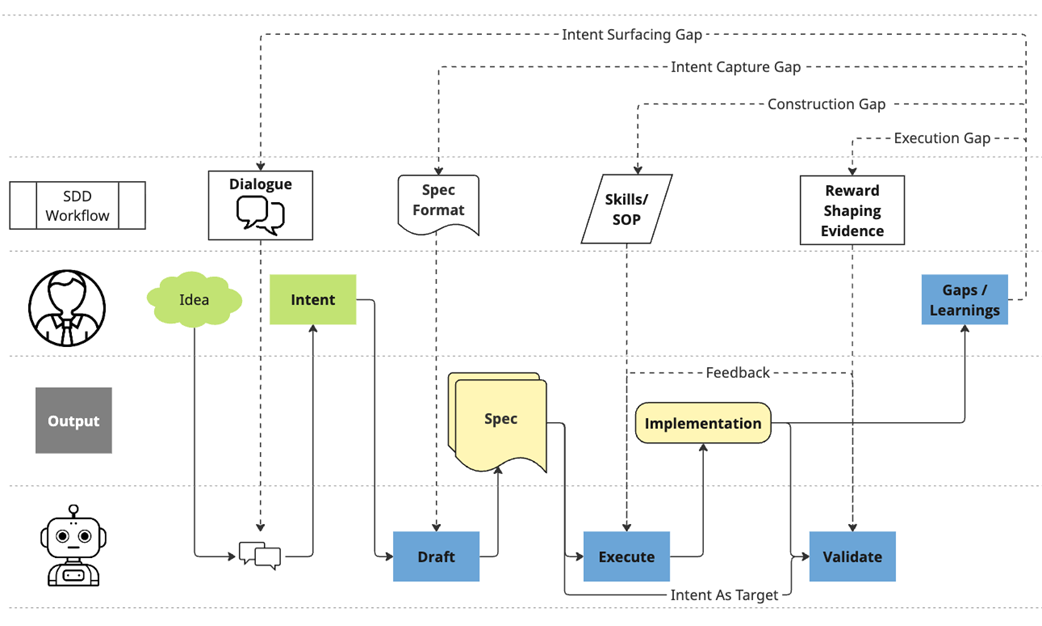
The feedback-loop diagram locates repairs at the stage where intent escaped, rather than treating every gap as another code patch. section 3.2.5