Independence means that observing one random variable does not change the distribution of another. For variables X and Y, this is expressed as P(Y|X) = P(Y), written X ⊥ Y. In predictive terms, X provides no predictive power for Y. Dependence means that this equality does not hold. section 2.1.9 section 2.3.3
Conditional independence in a family tree
A child’s blood type and a grandparent’s blood type can be correlated. Once the parents’ blood types are known, however, the child’s and grandparent’s blood types become conditionally independent: X ⊥ Y | Z, or P(Y|X,Z) = P(Y|Z). section 2.1.9
Independence is useful because it removes unnecessary conditioning from probability models. In a joint distribution P(W, X, Y, Z), X ⊥ W changes P(X|W) to P(X), while Z ⊥ Y | X changes P(Z|Y,X,W) to P(Z|X,W). Such constraints reduce the number of parameters and simplify model representation. section 2.1.9
Use independence as both a modeling assumption and an empirical constraint:
- Test whether observed variables support independence or conditional independence before relying on a causal model. section 2.3.3
- Treat a test result as evidence rather than proof; sample size and other factors can produce false conclusions. section 2.3.3
- Prioritize assumptions that enable downstream causal roles, such as an instrumental variable’s required independence from other variables. section 4.3.3
- Propagate independence into expectations: if X ⊥ Y, then E(X|Y) = E(X); conditional independence similarly removes irrelevant information given Z. section 2.1.10
Figure 2.14 How causality can induce conditional independence. The blood types of the parents cause the blood type of the child. The grandfather’s blood type is correlated with that of the child’s (dashed line). But the parents’ blood types are direct causes that fully determine that of the child. These direct causes render the child’s and grandfather’s blood types conditionally independent.
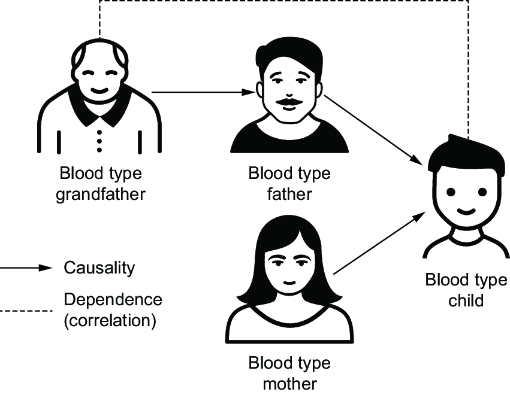
Trace how direct causal parents can render otherwise correlated variables conditionally independent. section 2.1.9
Figure 4.17 Z, X0, and X1 were included in the DAG because they play a useful role in analyzing the causal effect of U on Y. Their role depends on conditional independence, and it is important to test that they can indeed serve those roles.
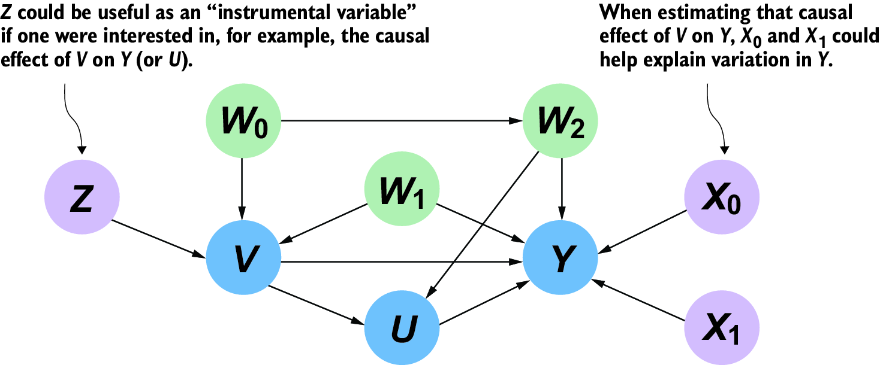
Inspect why specific conditional-independence assumptions matter when validating a causal graph and an instrumental-variable analysis. section 4.3.3






