Independence means that learning one event or variable does not change the probability distribution of another. For events A and B, P(A, B) = P(A) × P(B). Two fair coin tosses illustrate the idea: the first result does not affect the second, so two heads has probability 50% × 50% = 25%. section 7.1
Independence becomes especially useful when reasoning about conditioning and causal effects:
- Conditional independence holds when two variables become independent after focusing on cases with a particular value of a third variable. section 7.1
- In a randomized controlled trial, treatment T is independent of pre-treatment characteristics and potential outcomes, even though T can affect the observed outcome Y. section 10.3
- When treatment depends on confounders, conditioning on those confounders can restore independence between treatment and potential outcomes within each subgroup. section 10.3
Predictive variables and treatment
A variable can predict the outcome without predicting treatment. In that case, it is independent of treatment, so adjustment does not change bias, although it may reduce estimation variance. section 2.5.6
Figure 2.15 A predictive outcome variable predicts the outcome but not the treatment. In this case, there is no difference between applying the adjustment formula or just the difference of means from a bias point of view. However, adjusting for the predictive variable can be beneficial because it may decrease the variance of your estimations.
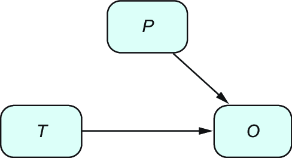
Use the causal diagram to distinguish a variable that predicts the outcome from one that creates treatment imbalance. section 2.5.6






