Reranking arranges selected recommendation candidates into the order a user sees. In a four-stage pipeline, retrieval finds candidates, filtering removes ineligible items, scoring estimates relevance, and final ordering combines those scores with business logic. Keeping ordering separate lets a system change presentation rules without retraining its scoring model. section 1.4.1 section 1.4.2
The final order can account for more than predicted relevance:
- Diversity and fairness can prevent an overly narrow set of results. section 1.4.1
- Freshness boosts, promotional slots, and deduplication across recommendation rows can change what appears first. section 4.6.5
- Context can change the order without changing the candidates: an afternoon visit might favor adventure comics, while an evening visit favors humor comics. section 1.3.3
Personalizing a popular-items row
A streaming carousel can retrieve currently popular titles for everyone, filter out ineligible titles, score the remainder for each user, then order them for presentation. Another approach starts with a user's candidates and boosts popular items. The source of candidates and the final order are separate choices. section 1.4.1 section 1.2.1
Evaluate the displayed list, not just the scorer. A diversity constraint may lower precision by replacing a highly relevant item with a less relevant but more varied one; that is a product trade-off, not necessarily a model failure. Track end-to-end precision, recall, NDCG, coverage, and diversity, then use stage-specific metrics to locate problems. Reranking cannot recover a relevant item that retrieval never supplied. section 4.6.5
Figure 1.14 The four-stage recommender system architecture. Candidates flow from left to right, being progressively filtered and refined at each stage. Early stages prioritize speed and recall; later stages prioritize precision and ranking quality.
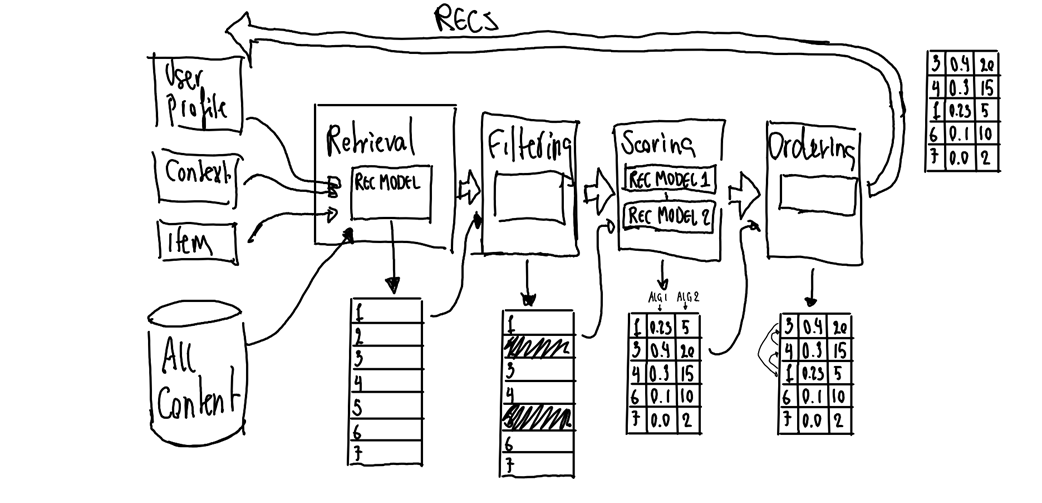
The pipeline diagram locates final ordering after retrieval, filtering, and scoring, where the candidate set has already been narrowed. section 1.4.1