A feed can rank several posts from one creator highly, then adjust their order so they do not all appear together. Reranking is an optional step that makes minor changes to an already ranked list before delivery. section 2.2 section 2.2.4
Platforms can use reranking to:
- Separate posts from the same creator or avoid placing ads next to each other, reducing feed fatigue or the impression of too much promotion. section 2.2.4
- Boost posts from verified public-health services, or downrank posts linking to competitors. These adjustments can reflect platform priorities, not just predicted user interest. section 2.2.4
Changing the mix of posts
In a study, researchers downranked posts expressing positive or negative sentiment for different user groups. The observed changes in users’ own posts were tiny, and the study could not establish causation. section 7.1
Figure 2.1 A bird’s-eye overview of a recommender system. Recommendations are not the output of a single operation; rather, they are the results of multiple interlinked operations. Candidates are generated from the universe of all possible content—for example, by picking posts from users that are followed. Later, candidates are filtered to restrict the pool to a more manageable number. At this stage, the content gets actively sorted by the Heavy Ranker in accordance with a predefined metric. Such a ranked list can be adjusted, if needed, before being delivered to the users, whose engagement is recorded. Platform policies influence the filtering and post-processing steps, for example, by limiting the amount of content from the same author.
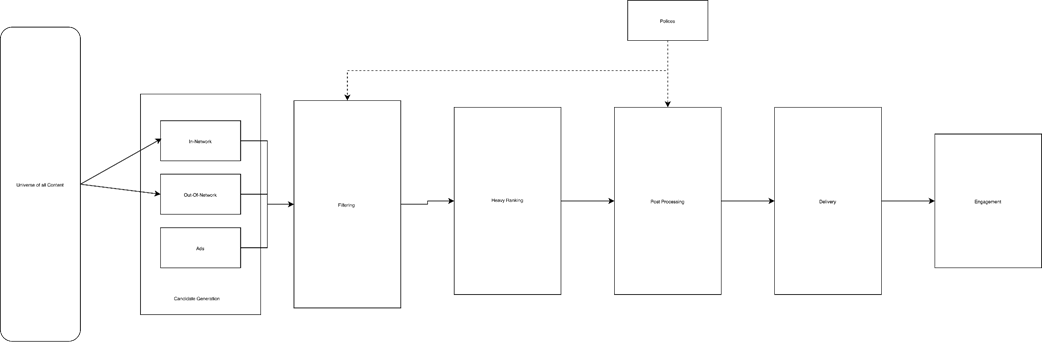
See where reranking sits between heavy ranking and delivery, alongside the other linked steps in a recommender system. section 2.2