A search system can first retrieve a broad candidate set with semantic embeddings, then reevaluate the original documents against the user query and reorder them. This recovers relevance signals lost when documents are compressed into dense numerical representations. section 7.2.4
A reranker is an additional supervised model fine-tuned for a specific use case. It analyzes each document’s meaning in query context, improving accuracy over embedding-only retrieval. The trade-off is speed: semantic search is fast because representations are precomputed, while reranking is slower, so it is applied after retrieving a larger candidate set rather than across the entire corpus. section 7.2.4
Recent cloud-computing reports
A search system can retrieve reports with embeddings, filter for recognized industry leaders and the past six months, then rerank the remaining documents for query-specific relevance. Timestamp-based ranking can additionally promote newer documents. section 7.2.4
Figure 7.7 Recap of the search system and optimization potentials
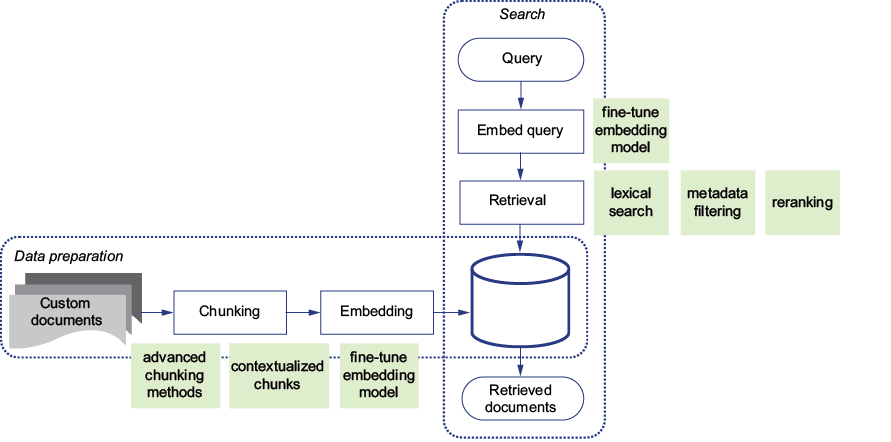
Use the search-system recap to place reranking after initial retrieval and alongside other optimization choices. section 7.2.4


