Information Security Continuous Monitoring (ISCM) is a cycle of defining what to watch, collecting security data, analyzing changes, and responding to findings. It keeps security decisions tied to current conditions rather than a one-time assessment. section 8.1
Build the monitoring program around decisions it needs to support:
- Set scope, strategy, and risk tolerance: identify the systems, assets, and vulnerabilities that need visibility. section 8.1 section 8.8
- Choose metrics, assessment frequency, and reporting channels. Deploy sensors or agents to collect network traffic, logs, application activity, and user behavior. section 8.1.2
- Analyze patterns and anomalies with automated tools and manual inspection. Add context, determine a response, and report actionable recommendations to stakeholders. section 8.1.2
- Act on detections and refine the system. Predefined responses can isolate an affected system, block a malicious IP address, or alert the security team. section 8.1
Read a monitoring dashboard as a risk signal
A security services provider’s dashboard recorded 6,000 failed logins in five minutes, 500 GB transferred from critical servers in an hour, and 2,000 files encrypted in a day. Those figures pointed to possible brute-force, data-exfiltration, and ransomware activity, but a flood of false-positive alerts was delaying response. The team revised thresholds using historical data, added granular logging and behavioral analytics, and compared results six months later. Interpret changed counts alongside investigation quality and response speed—not as proof of reduced risk on their own. section 8.3.1
Figure 8.2 The left side shows SecureTech’s initial continuous monitoring metrics on their example dashboard. On the right are the improved numbers 6 months after analysis and corrections.
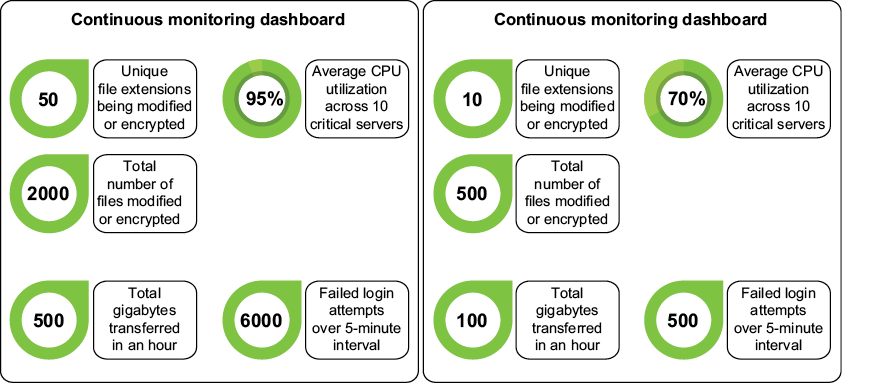
Compare the dashboard’s initial and six-month metrics, then ask which changes warrant investigation and which may reflect better alert filtering. section 8.3.1
Wazuh is one implementation option: endpoint agents send data to a central server for analysis and dashboard reporting. Its rules can alert on unusual logins, unauthorized file changes, and unexpected network connections. Monitoring also supports compliance checks and incident-response improvement; after an unauthorized-access incident, continued monitoring and weekly audits accompanied patching, access-control changes, and a shorter response-time target. section 8.2 section 3.4.2
