An input layer is the first neural-network layer. It receives input data and passes it to hidden layers, where processing, feature extraction, and learning occur before the output layer makes a prediction. section 8.2.3
Information moves through the network in a directed sequence:
- The input layer consumes raw or processed data, such as images. section 8.2.3 section 8.3.2
- Hidden layers transform the data using weights, bias terms, and activation functions. section 8.3.2
- The output layer uses the transformed information to produce a prediction. section 8.2.3 section 8.3.2
Image and face recognition
For image classification, the input layer receives raw or processed images. In a face-recognition task, it receives face images from different angles, which flow through transformation layers to produce a probability for a person’s identity. section 8.2.3 section 8.3.2
In a convolutional neural network, the input is generally an image tensor represented by width, height, and color channels. Convolution layers then scan it for visual patterns. section 8.6.1
Figure 8.4 A typical neural network with neurons and input, hidden, and output layers
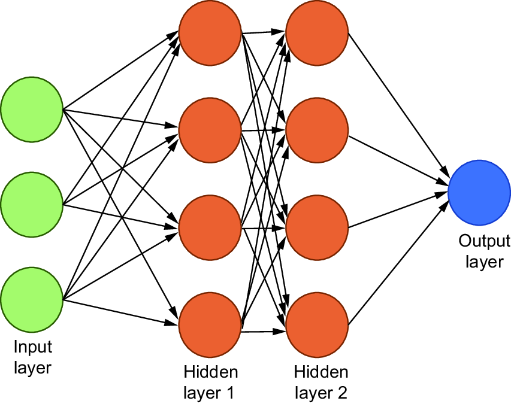
Use the network diagram to trace connections from input units through hidden layers to the output layer. section 8.2.3



