liveBook · Manning

Input layer

As explained in Inside AI

An input layer is the neural-network layer that receives the input data.

An input layer receives the data fed into a neural network. It begins the flow through an architecture that typically includes input, hidden, and output layers. section 3.3

A three-value input

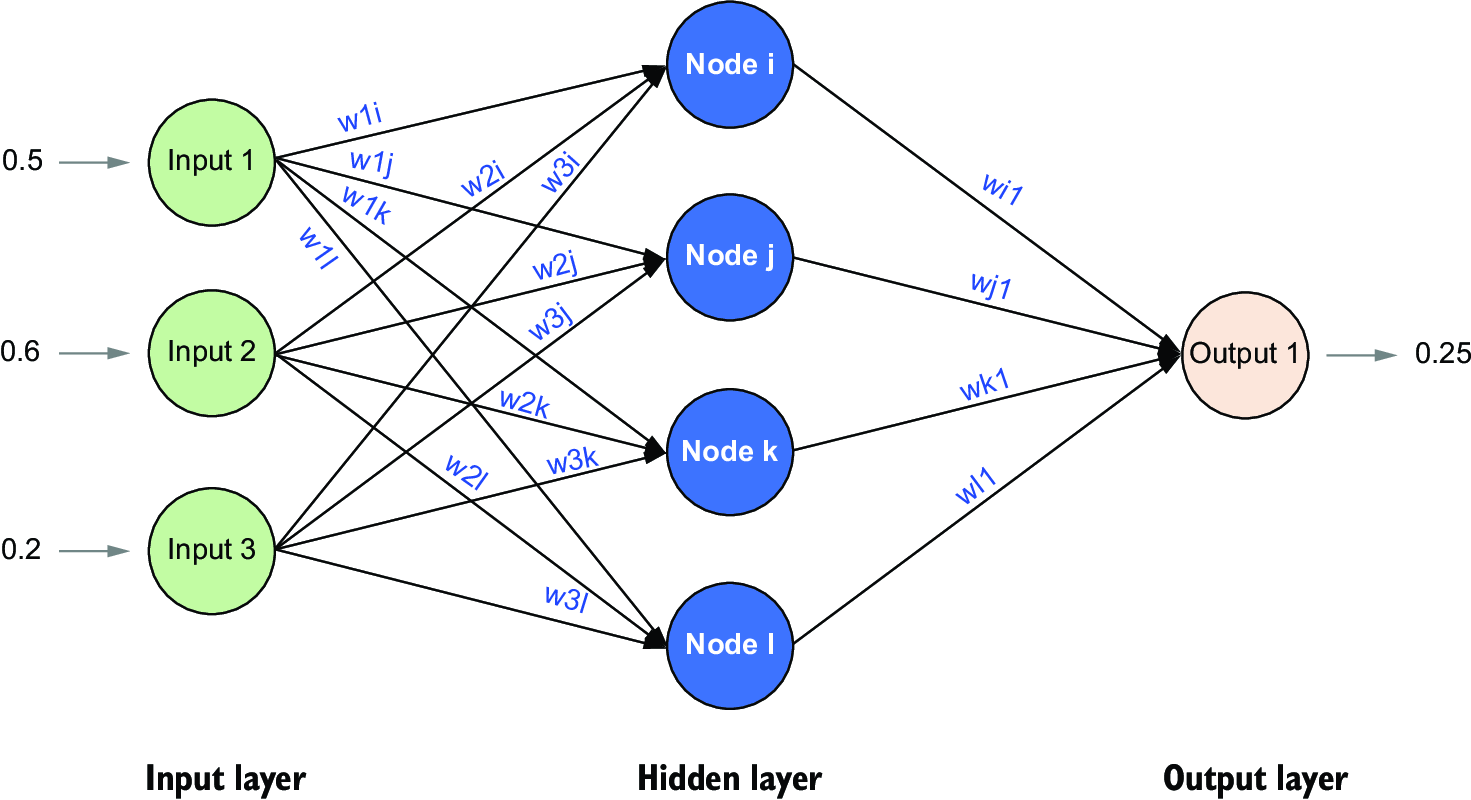
A backpropagation network can receive the values 0.5, 0.6, and 0.2 through its input layer. Nodes pass these values to the next layer through weighted connections; training later adjusts those weights when predictions differ from correct labels. section 3.3

Figure 3.3 A backpropagation model with three layers
figure

Use the three-layer backpropagation diagram to trace data from the input layer through hidden layers to the output layer. section 3.3


How Inside AI covers it

How deep it goes
Defines the layer and illustrates its values and connections without detailing its internal computation.
Examples
Uses input values 0.5, 0.6, and 0.2 in a three-layer backpropagation structure.
What you can do after
Evaluate how data enters a neural network and passes toward prediction through connected layers.
How it connects
Connects input data to hidden layers, output layers, artificial neurons, weights, thresholds, and backpropagation.

Also explained in

Compare how 4 books explain input layer →

Related concepts

This explainer was generated by Manning's knowledge graph from the text of Inside AI. The section links point to the parts of the book it draws on.

