An intelligent advisory system (IAS) supports human decision-making by providing information, insights, suggestions, and recommendations without executing actions independently. Unlike an autonomous system, it keeps the user responsible for decisions and benefits from interaction, contextual information, and explanatory feedback. section 2.2.2
An IAS typically provides:
- Decision support that helps users compare options and make informed choices. section 2.2.2
- Context awareness that adapts advice to user preferences and specific scenarios. section 2.2.2
- Interactive explanations that let users explore options, ask questions, and inspect recommendations. section 2.2.2
A hybrid IAS combines knowledge graphs (KGs) and large language models (LLMs). KGs contribute explicit, structured knowledge and interpretable reasoning; LLMs contribute natural-language understanding, contextual interpretation, and handling of ambiguity. Graph neural networks can add structural pattern detection, while LLMs explain resulting insights in accessible language. section 2.7 section 9.1
Healthcare advisory workflow
A healthcare IAS can detect entities in clinical language, retrieve information from knowledge sources, and disambiguate context-dependent mentions. For example, named entity disambiguation can distinguish ordinary Zika infection from congenital Zika infection before connecting each mention to a knowledge-base entity. In personalized medicine, graph models can process patient-similarity and biological-pathway graphs while an LLM synthesizes medical literature and clinical guidelines into treatment rationales. section 7.1 section 9.1
Figure 2.3 Differences between (a) an intelligent autonomous system and (b) an intelligent advisor system. The first acts on behalf of users, whereas the second only makes suggestions. In both cases, the intelligent system supports or helps the end user; it is not meant to replace the user.
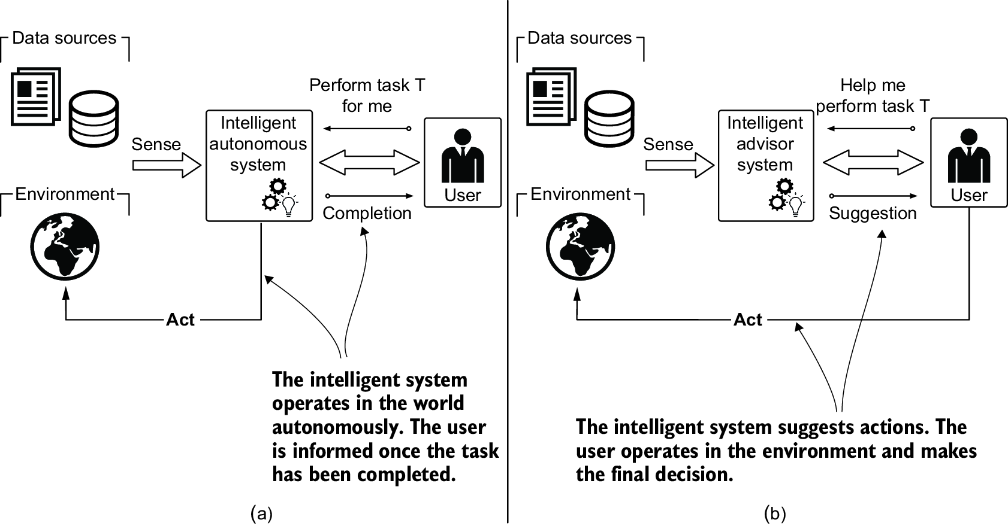
Compare an IAS with an autonomous system: the autonomous system acts on behalf of the user, whereas the IAS only makes suggestions. section 2.2.2
