An intelligent system connects users to artificial intelligence and machine learning to achieve meaningful objectives. It acquires knowledge, applies reasoning, uses contextual information, and improves through user interaction and feedback. Its role may be to support human decisions or, in autonomous settings, act on a user’s behalf. section 2.1 section 2.2.1
Design an intelligent system around four architectural elements:
- Knowledge bases represent and maintain domain knowledge, including acquired information, expert input, and contextual data. section 2.1 section 2.2.3
- Reasoning engines analyze knowledge, apply rules, and convert information into conclusions or actionable expertise. section 2.1 section 2.2.3
- Knowledge acquisition collects information from data sources, environments, domain experts, and user feedback. section 2.2.3
- Orchestration coordinates multiple algorithms and tools, passing outputs between processes while managing risk and quality. section 2.2.3
Medical diagnostic advisor
A medical diagnostic system can combine generic medical knowledge with patient context to suggest queries, tests, or therapies. It supports physicians rather than replacing their expertise, and it can extend its knowledge through feedback about suggested actions. section 2.2 section 2.2.1 section 2.2.3
Distinguish the two primary operating modes:
- Intelligent autonomous systems make decisions and execute tasks independently, adapting to real-time conditions. section 2.2.2
- Intelligent advisor systems provide context-aware information, explanations, and recommendations while leaving decisions with users. section 2.2.2
Figure 2.4 Extended model of an intelligent system. The focus is on the core components (the knowledge base and the reasoning engine) and the core processes (knowledge acquisition and reasoning).
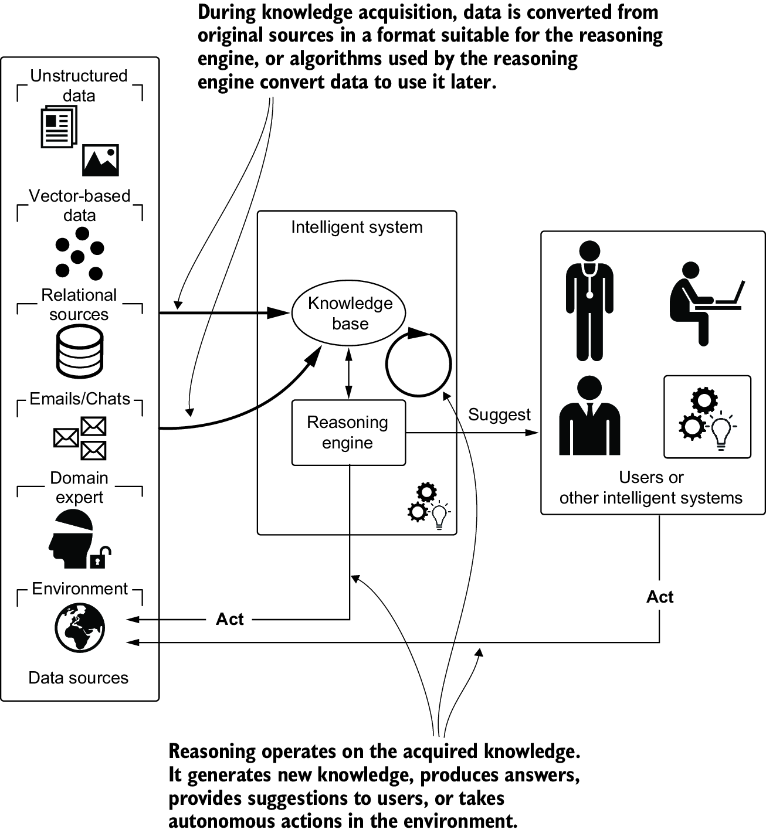
Use the extended architecture to trace how knowledge bases, reasoning engines, knowledge acquisition, and reasoning work together. section 2.2.3
