Interactive programming means writing code and getting immediate feedback. When exploring a large dataset, you can load it once, inspect a result, then revise the next analysis without reloading the data. An average, maximum, or histogram can suggest what to try next. section 1.3.1
That short feedback loop contrasts with a compile-launch-load workflow, where each change can mean repeating a costly data load. Julia pairs this interactive style with the performance needed for demanding scientific work. section 1.3.1 section 1.9
Try the Julia REPL
At the Julia prompt, enter `reverse("abc")` to get `"cba"`, or `3+5` to get `8`. Each expression is evaluated when you press Enter, making the REPL useful for experimentation, testing, and debugging. section 1.8
Figure 1.1 In dynamically typed languages you can ping-pong between coding and observing. Large data sets do not need to be reloaded into memory.
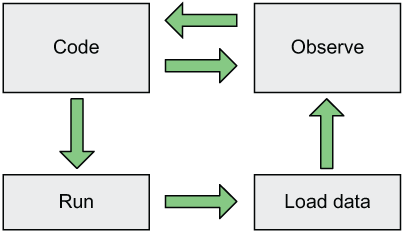
The figure shows the coding-and-observing loop: revise an analysis and inspect its result while the large dataset remains loaded. section 1.3.1
