The inversion operator is the amplitude-reflection step in Grover search. After a quantum oracle tags good outcomes by multiplying their amplitudes by −1, inversion increases the magnitudes of tagged outcomes and decreases those of untagged outcomes. Repeating oracle plus inversion raises the probability of measuring a desired result. section 6.0 section 6.3
Geometrically, inversion reflects the current state vector relative to the state used as the reference. For each outcome k, compute the inner product of the original and current state vectors, multiply it by original[k], then reflect current[k] about that point. The inner product is a complex similarity measure whose magnitude is at most 1. section 6.1.3
Figure 6.8 The value new [k] is the inversion of current [k] around the point ⟨original,current⟩original[k].
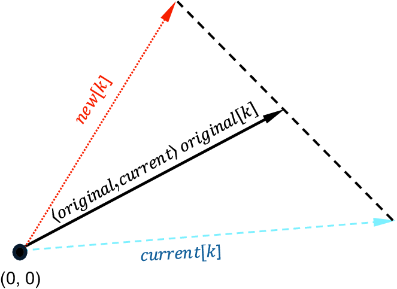
This vector view shows the per-amplitude reflection: new[k] is the mirror image of current[k] around ⟨original,current⟩original[k]. section 6.1.3
Uniform three-qubit state
Start with eight equal amplitudes, save that state as the reference, and let an oracle tag outcome 3. For this equal-superposition setup, the reflection can be expressed as `state[k] = 2*amplitude_mean - state[k]`. The tagged amplitude grows after inversion, while the other amplitudes are reduced. section 6.1.3
With state preparation operator A, the same reflection can be implemented as M = AM0A−1. First apply A−1 to return to the computational basis, apply M0, then apply A again. In the circuit-oriented form, an efficient sign-flip variant of M0 changes the amplitude of outcome 0 while leaving the others unchanged; this choice preserves Grover-iteration outcome probabilities. section 6.1.5 section 6.2.2
Figure 6.22 Circuit diagram for the magnitude amplification procedure GjA, where the operator g consists of an oracle O and the inversion operator M = AM0A–1
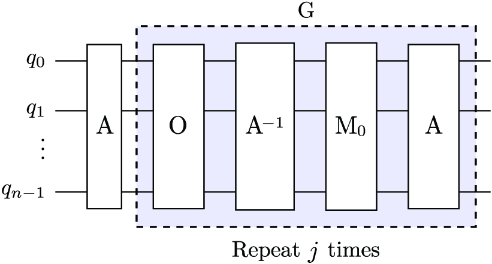
The circuit diagram places inversion as AM0A−1 inside magnitude amplification, following the oracle within each Grover iterate. section 6.1.5
The reusable pattern is a Grover iterate: apply oracle O, then inversion M, and repeat. If A prepares the starting state, the overall amplification procedure has the form GjA. Each iteration changes the combined probabilities of good and bad outcomes, so the iteration count matters. section 6.1.4
