Jaccard similarity, also called Tanimoto similarity, compares two sets or binary molecular fingerprints by dividing shared nonzero features by all nonzero features present in either fingerprint. Scores range from 0 (no shared features) to 1 (complete feature overlap); a score of 1 does not prove two molecules are identical. section 2.5.1
In ligand-based screening, fingerprints act as coordinates in feature space: nearby molecules are more alike according to the selected representation. Similarity searching uses this score to find compounds resembling a query molecule. section 2.5.1
Interpret a similarity search with these practical cautions:
- Compare thresholds within the chosen metric: Dice scores are generally greater than or equal to Tanimoto scores, so the same threshold can produce more hits with Dice. section 2.5.2
- Treat thresholds as representation-dependent: descriptors can make searches overly conservative or retain too many false-positive hits. section 2.5.2
- Use approximately 0.85 over common 2D fingerprints only as a rule of thumb for likely shared biological activity among drug-like molecules. section 2.5.2
Query-based screening
Generate molecular fingerprints, select one compound as a query, compute bulk Tanimoto or Dice scores against a library, inspect the highest and lowest matches, then retain compounds above a chosen threshold.
Figure 2.16 Mathematical definition of Tanimoto and Dice similarity coefficients with example computation for assessing the similarity of molecule A to molecule B.
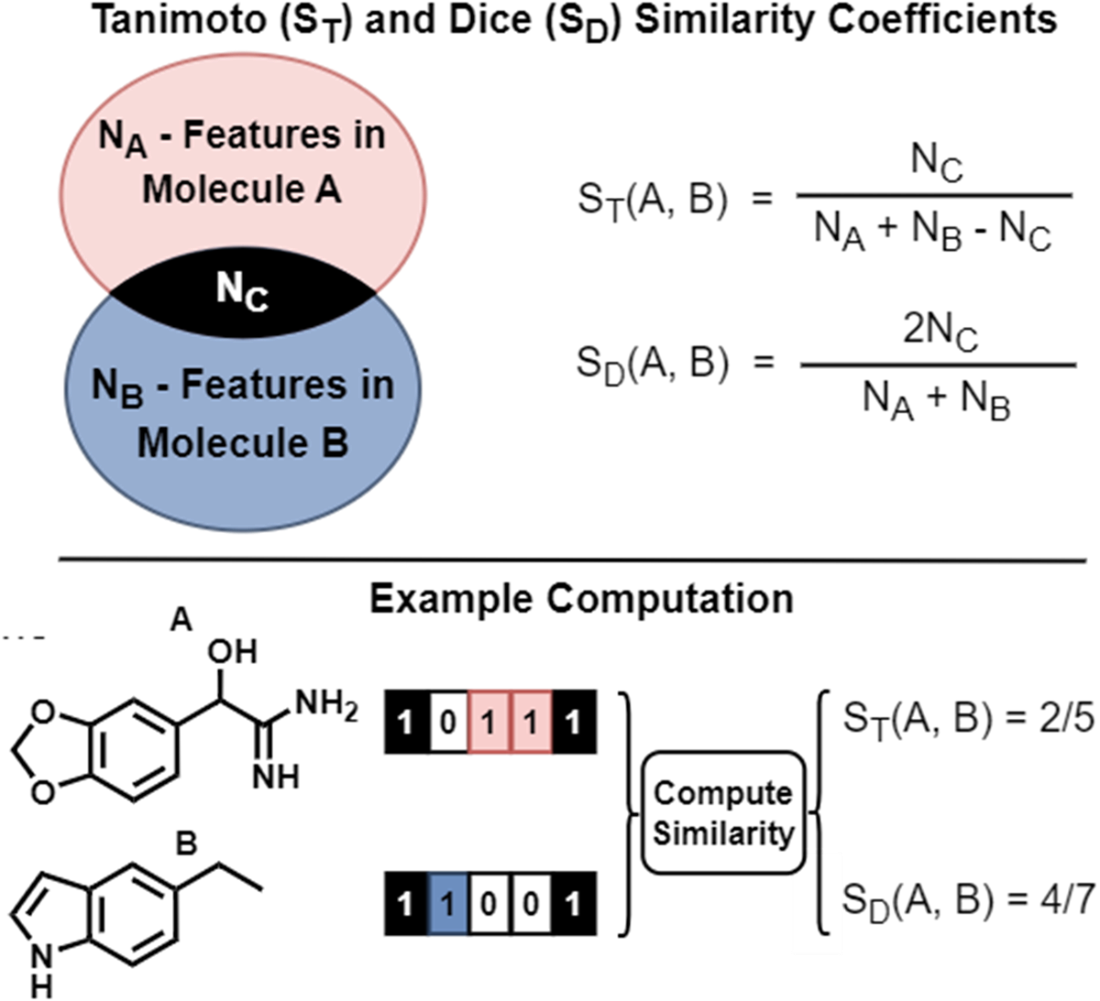
Use the mathematical comparison and worked feature-overlap example to distinguish Tanimoto from Dice similarity. section 2.5.1


