Jitter is variation in when a time-sensitive event actually occurs. In robot software, it commonly appears when interrupt latency—the delay between a hardware interrupt and its interrupt service routine (ISR)—changes from one occurrence to the next. The average delay may be acceptable while individual reactions arrive earlier or later. section 3.5
Treat jitter as a timing-quality problem, not simply a speed problem. A robot can execute an ISR quickly yet still react inconsistently if scheduling and computer behavior make the interrupt-to-ISR delay variable. That variation matters when software must respond within deadlines or run a control loop at a stated period with an allowed tolerance. section 3.5 section 3.6
Figure 3.15 When hardware triggers an interrupt to execute an interrupt service routine (ISR), interrupt latency delays the reaction. This duration varies over time, a deviation known as jitter.
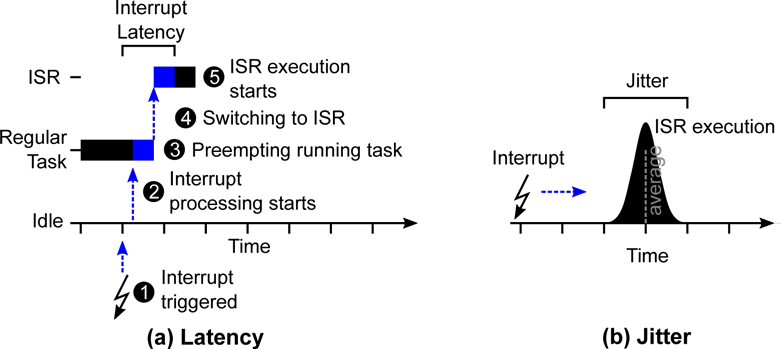
The timeline separates the hardware interrupt from ISR execution: latency is the delay, and jitter is the changing size of that delay across events. section 3.5
In a hard real-time robot system, manage jitter alongside related timing constraints:
- Measure timing against deadlines or periodic requirements rather than relying only on typical behavior. section 3.6
- Account for interrupt latency when an ISR must react to a hardware event. section 3.5
- Consider worst-case execution time (WCET), priority scheduling, synchronization, and jitter together when establishing real-time guarantees. section 3.6
Periodic motor-current control
A control loop may be required to adjust motor current every X microseconds, with only a defined plus-or-minus timing variation. Jitter is the departure of actual loop timing from that permitted cadence; if it exceeds the allowed range, the periodic requirement is not met even when the loop still runs. section 3.6

