liveBook · Manning

Similarity search

As explained in Optimization Algorithms: AI techniques for design, planning, and control problems

A systematic examination of possible states that begins at an initial state and seeks to reach a goal state.

Search systematically examines feasible states, starting from an initial state and aiming for a goal. In optimization, it seeks feasible solutions that maximize or minimize an objective. section 1.1 section 1.5

Search involves balancing exploration of new regions against exploitation of regions where promising solutions have already been found. Whether to apply optimization also depends on the problem’s scale and the costs of implementation. section 1.5 section 1.1

A small delivery problem

A pizzeria making about ten deliveries on an average weeknight might consider route improvements, but the problem may be too small for those changes to produce noticeable benefits. section 1.1

Figure 1.10 Search dilemma—there is always a trade-off between branching out to new areas of the search space or focusing on an area with known good or elite solutions.
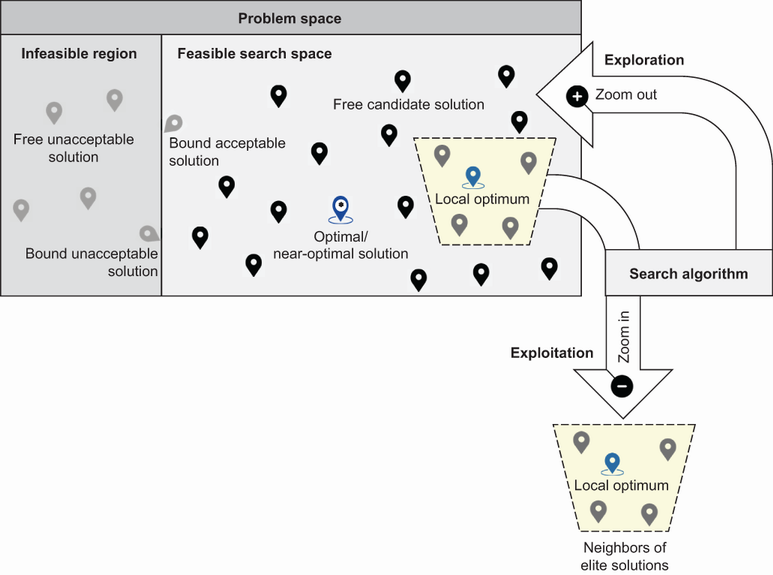
The figure illustrates the trade-off between exploring new search-space regions and focusing on regions with known good solutions. section 1.5

How Optimization Algorithms: AI techniques for design, planning, and control problems covers it

How deep it goes
Defines feasible-state search and explains exploration versus exploitation, but does not detail specific search algorithms here.
Examples
Uses small-pizzeria delivery planning and restaurant choice to illustrate practical scale and exploration followed by focused selection.
What you can do after
Evaluate whether optimization is worthwhile by weighing problem scale, implementation costs, expertise, and expected savings.
How it connects
Connects search to optimization, feasible search spaces, constraints, objective functions, and exploration–exploitation.

Also explained in

Compare how 22 books explain similarity search →

Related concepts

This explainer was generated by Manning's knowledge graph from the text of Optimization Algorithms: AI techniques for design, planning, and control problems. The section links point to the parts of the book it draws on.