The Kubernetes API provides the building blocks for composing platforms on top of Kubernetes. It supports declarative workflows and connects platform capabilities with developer delivery needs. section 1.0 section 1.2
Kubernetes is better understood as a meta-platform than as a complete platform: its APIs, CLI, dashboard, and ecosystem support domain-specific platforms for delivery, provisioning, monitoring, and developer experience. section 1.2
Platform teams use Kubernetes APIs to:
- Compose higher-level tools from Kubernetes building blocks. section 1.2
- Provide cloud-agnostic workflows for packaging, deploying, running, and monitoring workloads. section 1.2
- Extend Kubernetes for continuous integration, continuous delivery, cloud-resource provisioning, monitoring, observability, and developer experience. section 1.2
- Expose platform capabilities through Kubernetes conventions such as declarative behavior, versioning, and the resource model. section 6.2
A platform API built with Kubernetes conventions
A platform team can run platform-wide tools in a separate management cluster and host its platform API there, leaving workload clusters focused on applications. Reusing or extending the Kubernetes API gives the platform declarative behavior, versioning, the resource model, and compatibility with CNCF tools. Teams may also add an organization-specific API when company standards or non-Kubernetes users require a different interface. section 6.2
Figure 1.10 Kubernetes offer us a CLI, SDKs and dashboards, is it a platform?
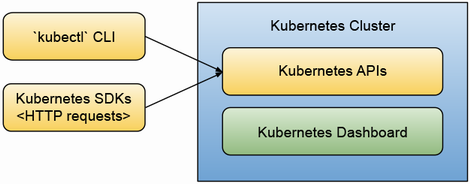
Use the figure to distinguish Kubernetes APIs, CLI, SDKs, and dashboards from the broader platform capabilities built on top of them. section 1.2





