Google Kubernetes Engine (GKE) is Google Cloud’s managed Kubernetes service for running containerized workloads. Its native cloud offering automates cluster installation: administrators provide node sizes, node counts, zones, and regions, then deploy applications to a ready cluster. section 3.1.3 section 16.2
GKE supports several operational patterns:
- Provision clusters quickly through cloud-provider automation rather than installing Kubernetes manually. section 3.1.3
- Use Anthos to maintain a common Kubernetes environment across Google Cloud, on-premises systems, AWS, and Azure. section 3.1.3 section 16.2
- Inspect cluster locations, types, labels, warnings, Kubernetes versions, available CPU and memory, and enabled features from a centralized cluster view. section 2.4.4
- Combine the runtime with centralized configuration, service-mesh security and observability, logging, monitoring, auditing, and troubleshooting. section 16.2
Deploying Elasticsearch through Marketplace
Select an Elasticsearch solution, choose the GKE cluster and namespace, and retain the demonstrated defaults: the us-central-1 region, instance name elasticsearch-1, and two replicas. Marketplace creates the cluster, deploys the application components, and exposes the resulting solution for management and CPU, memory, and disk monitoring through Anthos. section 14.2.1
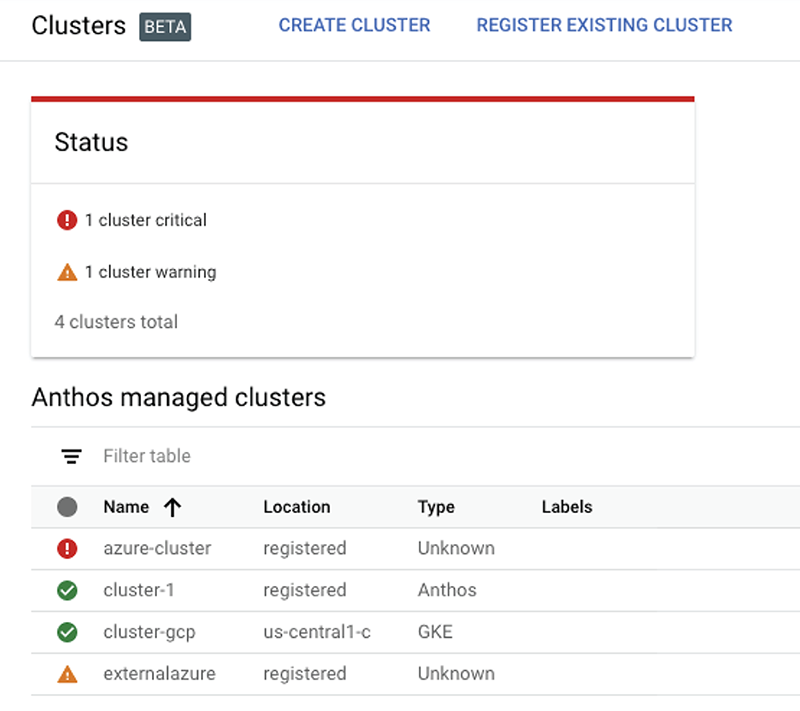
The cluster list provides a compact operational inventory, showing locations, types, labels, and warnings across the current fleet. section 2.4.4


