A Kubernetes resource is a declarative YAML object that configures how containerized services run, communicate, and receive traffic in a cluster. Developers inspect and apply resources with kubectl while investigating a running application. section 2.0 section 2.1.2
Common resource kinds divide deployment, networking, and configuration responsibilities:
- Deployments declare the required number of container replicas and configure the containers, including environment variables. section 2.1.2
- Services route traffic to deployment containers, balance requests across replicas, and provide service discovery through stable service names. section 2.1.2
- Ingresses route traffic from outside the cluster to selected services. section 2.1.2
- ConfigMaps and Secrets store configuration for service instances; Secrets protect sensitive information. section 2.1.2
Conference application
Package each Conference application service as a container image, define its Kubernetes resources in YAML, install the services with Helm, and inspect the resulting resources with kubectl in a local KinD cluster. section 2.0 section 2.1.2
Figure 2.2 Templating engines render YAML resources by replacing variables.
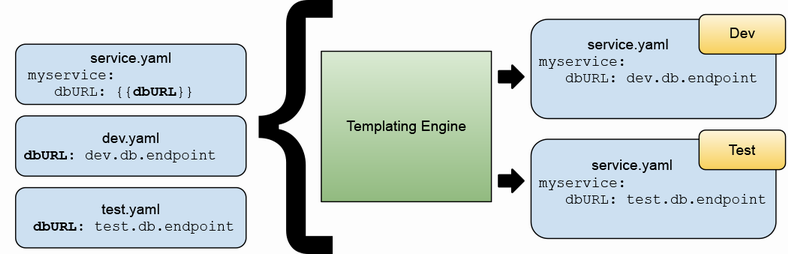
Templating engines render Kubernetes YAML resources by replacing variables, helping manage configurations that would otherwise become difficult to maintain. section 2.1.2
Resources are composable but become cumbersome at application scale. Release strategies such as canary, blue/green, and A/B deployments may require coordinated changes across deployments, services, and ingress rules, making manual application error-prone. section 8.1.4




