The last responsible moment is the latest point at which a decision can be made without sacrificing responsible action. It balances learning against delivery, financial, operational, and strategic risk: decide too early and assumptions become constraints; decide too late and pressure removes flexibility. section 4.4 section 3.7
The principle applies mainly to decisions that are expensive or difficult to reverse. It does not recommend indecision. It recommends delaying commitment while waiting still preserves useful options, then acting when the cost of waiting exceeds the value of learning more. section 4.4 section 4.4.1
Before committing, test whether the decision is genuinely needed now:
- Identify the concrete work blocked by postponement. section 4.4.1
- Name the assumption the decision would lock in and the information waiting could reveal. section 4.4.1
- Estimate reversal costs over the coming months rather than treating current certainty as free. section 4.4.1
- Preserve the larger choice through a seam, adapter, feature flag, versioned contract, or architectural decision record. section 4.4.1
- Define the signal that will show waiting has become unsafe. section 4.4.1
Recognizing premature commitment
Selecting a domain model before it is understood, finalizing integration contracts too early, choosing an architectural pattern before clarifying the problem, or adopting technology without considering team skills can create costly lock-in. Deferring the decision is useful only while it does not increase real delivery risk. section 4.4.1
Figure 4.2 Architectural decisions are most effective when made at the last responsible moment: late enough to preserve flexibility, but early enough to avoid delivery risk.
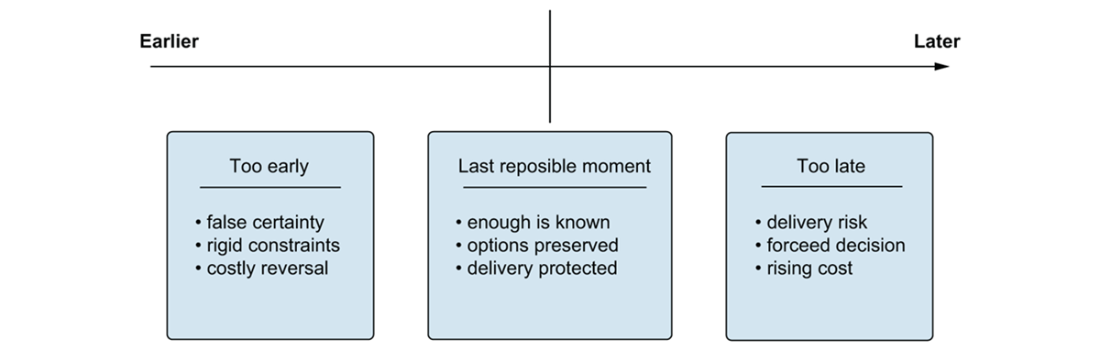
Use the decision-timing model to distinguish assumptions made too early, action at the last responsible moment, and pressure-driven choices made too late. section 4.4


