Last-write-wins is ScyllaDB’s default way to reconcile conflicting writes. Each non-primary-key value is stored as a cell with a microsecond-precision write timestamp. When replicas hold different versions of that cell, the value carrying the latest timestamp wins and is eventually replicated as the final value. The number of replicas that first acknowledged a write does not decide the winner. section 6.1.2
This rule is simple and predictable, but it can lose a valid update. If Edith updates an author bio with QUORUM consistency and Emily writes a different bio milliseconds later with ONE consistency, Emily’s later timestamp wins even though Edith’s write reached more replicas. Last-write-wins considers timestamps, not editor intent, messages, or other application context. section 6.1.2
Work with write timestamps deliberately when the ordering of updates matters:
- Inspect a column’s stored timestamp with WRITETIME(column) to see which version is eligible to win. section 6.1.2 section 6.6
- Override the default coordinator-based timestamp with USING TIMESTAMP on an UPDATE or INSERT when a write needs a specific ordering. section 6.1.2 section 6.6
- Use conditional updates through lightweight transactions when an update must depend on the row’s current state rather than simply accepting the latest write. section 6.5
- Consider client-side coordination, such as distributed locking, when preserving context across concurrent edits matters. section 6.1.2
Protecting a live update during migration
A migrator can conflict with an application that is dual-writing during a database move. It may read an older article, then insert that copy after an editor has changed the article. If the migration insert has the higher timestamp, it overwrites the editor’s newer data. Set USING TIMESTAMP to a value no later than the moment migration reads begin; preferably use the source database’s write or modified timestamp. That lets subsequent live updates retain later timestamps and win. section 12.2.4
Figure 6.1 In Scylla, the write timestamp of a query takes precedence over the number of replicas a node is stored on.
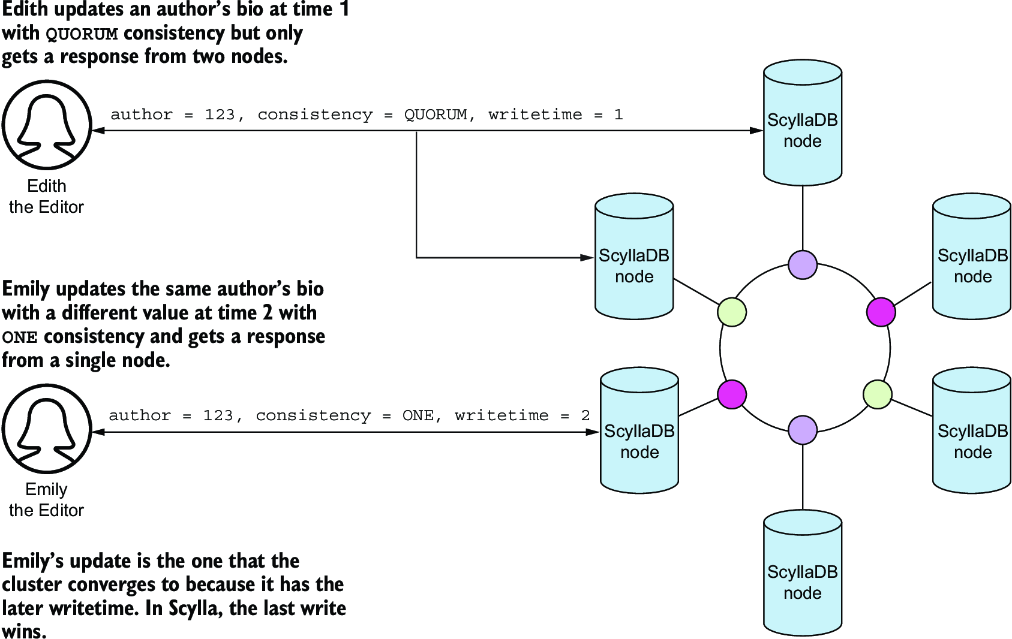
Compare the two concurrent writes: a later write timestamp wins even when an earlier write was acknowledged by more replicas. section 6.1.2
