liveBook · Manning

Law of Truly Large Numbers

As explained in Grokking Statistics

The principle that a sufficiently large collection of opportunities makes the occurrence of even extremely unlikely events probable somewhere.

The law of truly large numbers says that a large enough collection of opportunities makes even extremely unlikely events likely to occur somewhere. It explains why rarity alone does not prove that an unusual outcome was unforeseeable. section 4.7

When “six sigma” becomes an excuse

An investment expected to return $50,000 instead returns $5,000, six standard deviations away. Calling this a six-sigma event may sound like an explanation, but the model itself may have used the wrong mean or standard deviation. A large collection of possible events makes some extreme outcomes likely, while flawed assumptions can make them appear even more surprising. section 4.7

Figure 4.11 An investor blames an unlikely six-sigma event for a misfortune.
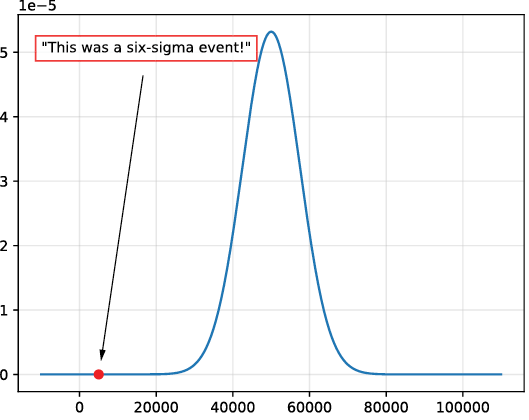
Use the illustration to examine how an investor attributes a business misfortune to an unlikely six-sigma event. section 4.7

How Grokking Statistics covers it

How deep it goes
Defines the principle and applies it critically to sigma claims, stopping short of formal probability calculations or derivations.
Examples
Uses a six-sigma investment loss, 25-sigma crisis claims, and the unusually severe business effects of COVID-19.
What you can do after
Evaluate claims about rare events by checking whether the underlying model captured reality before blaming variability.
How it connects
Connects rare events with normal distributions, standard deviation, bell curves, black swan events, and model assumptions.

This explainer was generated by Manning's knowledge graph from the text of Grokking Statistics. The section links point to the parts of the book it draws on.