Lead time is the elapsed time from committing code until it successfully reaches and runs in production. It is one of the four DORA metrics used to assess delivery performance. section 4.4.2 section 2.5
Use lead time to decide whether delivery or code review needs attention:
- A low-performing team has a lead time of one to six months. section 4.4.2
- A medium-performing team has a lead time of one week to one month. section 4.4.2
- If lead time is slow, inspect code reviews and other deployment-pipeline bottlenecks rather than assuming reviews are the cause. section 4.4.2
A review bottleneck
When code reviews contribute to longer deployment times or slower lead time, check whether one person’s approval is routinely required. Spread that person’s knowledge over time to reduce dependency and approval burden. section 4.4.2
Figure 4.2 Distributed teams can use bookend meetings to decrease code review delays.
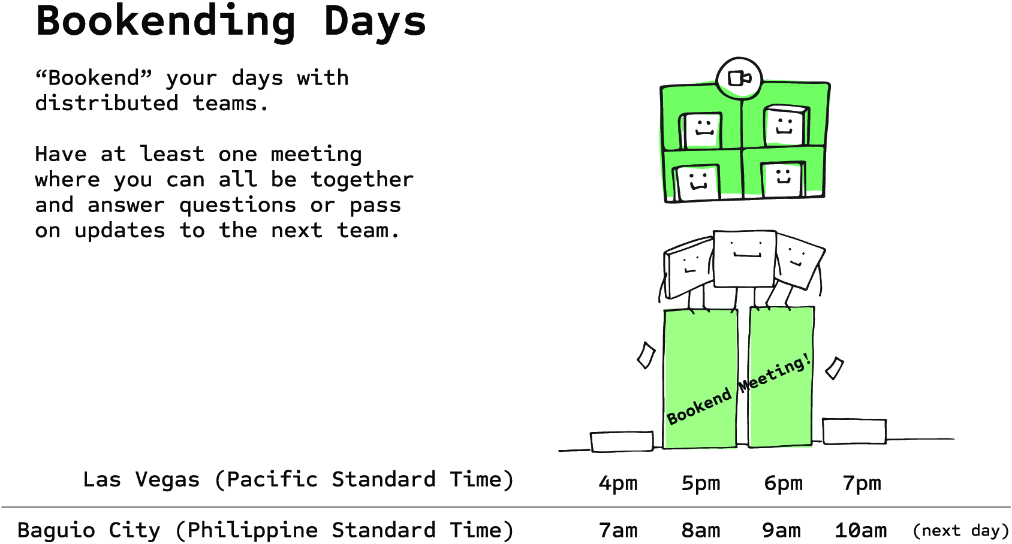
Distributed teams can use bookend meetings to decrease delays in code review and protect lead time. section 4.4.2





